
You spend money on advertising. The campaign runs. But how do you actually know if it worked?
That question has haunted marketers for decades. And in 2026 — with budgets under more scrutiny than ever — not having a clear answer is no longer acceptable.
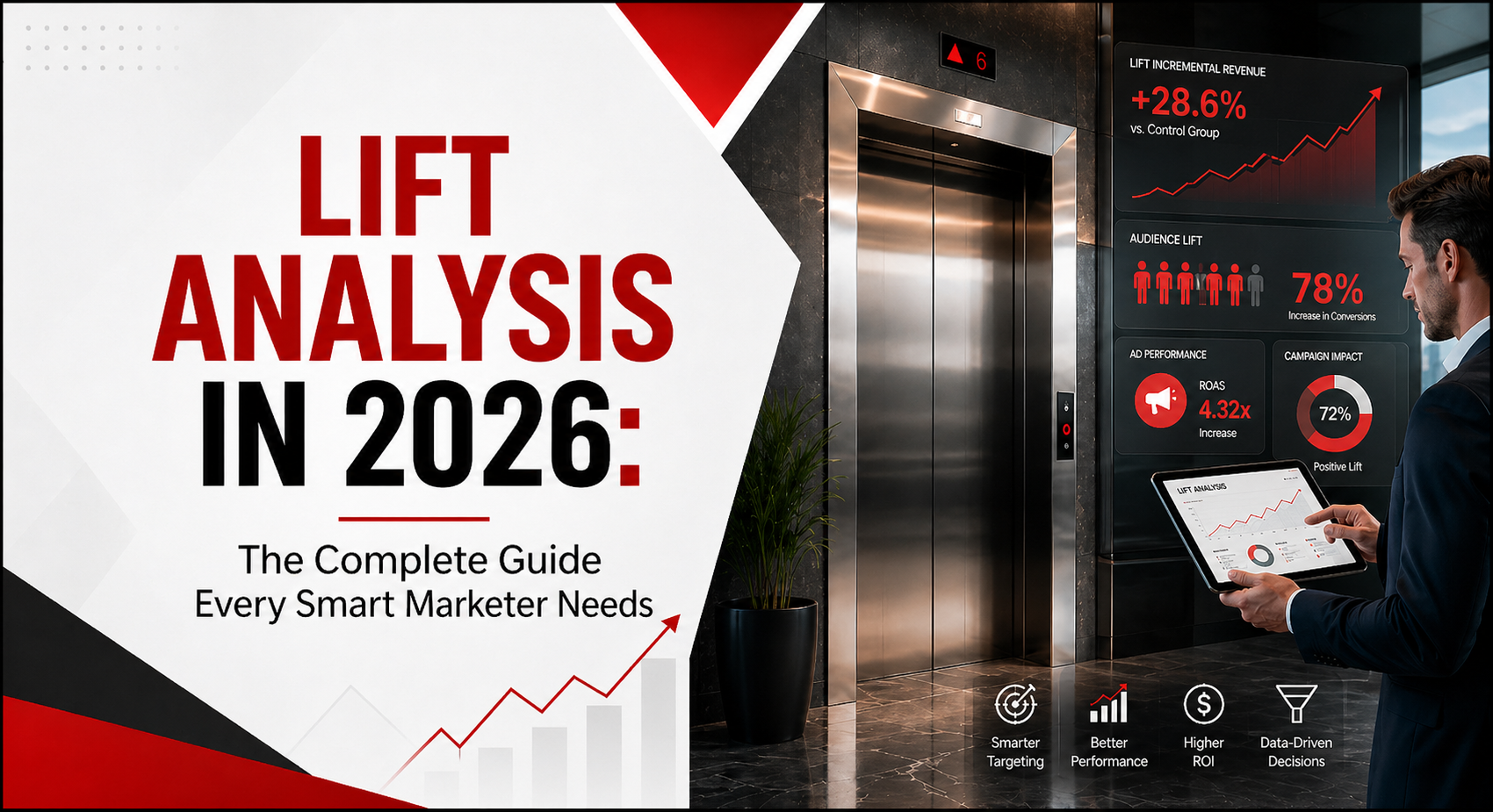
This is exactly where lift analysis in 2026 becomes one of the most powerful tools in a marketer’s arsenal. Whether you run digital ads, social media campaigns, or offline advertising like elevator branding — lift analysis tells you what is actually moving the needle and what is just spending money.
At Liftup Marketing, India’s elevator advertising specialists operating across Delhi NCR since 2017, we use lift analysis every single day to prove the impact of residential lift campaigns for our clients. And in this guide, we are going to break it all down for you — clearly, practically, and without the jargon.
Let us start from the beginning.
WhatsApp Now : 972-932-1918
What Is Lift Analysis? A Clear, Simple Definition
Before we dive deep, let us answer the most basic question: what is lift analysis?
Lift analysis is a method of measuring the incremental impact of a marketing campaign. In simple terms, it tells you how much a campaign actually increased a desired outcome — like brand awareness, website visits, store footfall, or sales — compared to what would have happened without the campaign.
The word “lift” refers to the uplift — the extra performance you get because of your marketing effort.
Here is an easy example:
Imagine 100 people were going to buy your product anyway, even without seeing your ad. You run a campaign. After the campaign, 130 people buy. That extra 30? That is your lift. Your campaign created a 30% lift in purchases.
Lift analysis answers the question: “What did my campaign actually cause — and what would have happened anyway?”
This distinction matters enormously. Because without lift analysis, marketers often take credit for outcomes that would have happened regardless of their campaign — leading to inflated ROI numbers and misplaced budget decisions.
Why Understanding Lift Analysis Matters More in 2026
We live in the age of accountability marketing. Brands are no longer satisfied with vanity metrics — impressions, reach, engagement. They want to know: did this campaign actually drive business results?
Several things have made lift analysis more important than ever in 2026:
Rising Ad Costs Digital advertising costs have increased significantly over the past three years. Every rupee of ad spend is now scrutinised more carefully. Marketers need to justify every campaign with real outcome data — not just reach numbers.
Consumer Fatigue People see thousands of ads every day. Brand recall from a single campaign is harder to achieve. Understanding what actually caused a consumer to act — rather than what they happened to be exposed to — requires proper lift measurement.
Multi-Channel Complexity Most campaigns today run across multiple channels — digital, social, OOH, print, radio. Understanding which channel drove which outcome requires lift analysis at the channel level. Without it, budget gets misallocated to channels that look effective but are not actually driving incremental results.
Growing OOH and Elevator Advertising Outdoor advertising — including elevator and lift advertising — has seen strong growth. But proving its impact requires a structured lift measurement approach. This is something Liftup Marketing has been building into every campaign for years.
Privacy Changes Cookie deprecation and data privacy regulations have reduced the amount of individual-level tracking available in digital. Lift analysis at the group or panel level has become an increasingly important alternative.
WhatsApp Now : 972-932-1918
The Science Behind Lift Analysis — How It Actually Works
Understanding lift analysis means understanding its core methodology. Here is how it works in practice.
The Test and Control Group Method
The most reliable form of lift analysis uses two groups:
Test Group (Exposed): People or areas that are exposed to your campaign. Control Group (Unexposed): People or areas that are similar in all ways — but did NOT see your campaign.
By comparing the behaviour of both groups after the campaign, you can isolate the true impact of your marketing. Any difference in outcome between the two groups is the lift your campaign created.
This method removes the impact of external factors — seasonal trends, economic changes, competitor activity — that would affect both groups equally. What is left is the pure effect of your campaign.
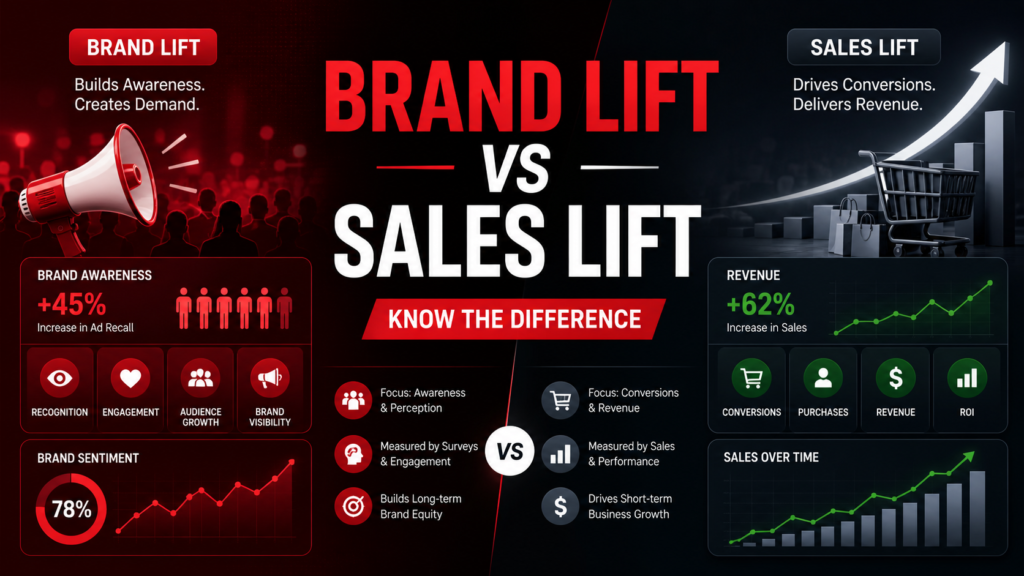
Brand Lift vs Sales Lift — Know the Difference
Lift analysis can measure different types of outcomes:
| Type of Lift | What It Measures | Best For |
| Brand Lift | Awareness, recall, consideration, preference | Brand building campaigns |
| Sales Lift | Direct revenue or transaction increase | Performance campaigns |
| Footfall Lift | Increase in physical store or location visits | Local and OOH campaigns |
| Search Lift | Increase in branded search queries | Brand awareness campaigns |
| Engagement Lift | Website visits, app opens, content interactions | Digital campaigns |
| Conversion Lift | Increase in specific actions — sign-ups, downloads, leads | Direct response campaigns |
At Liftup Marketing, when we run residential elevator advertising campaigns in areas like Indirapuram, Vaishali, Vasundhara, and Noida — we primarily measure brand lift (awareness and recall) and search lift (increase in branded search queries from that pincode area).
WhatsApp Now : 972-932-1918
Lift Analysis in 2026: What Has Changed
Lift analysis is not a new concept — but how it is done in 2026 has evolved significantly. Here is what is new and important:
1. AI-Powered Lift Measurement
Artificial intelligence is now being used to build more precise control groups — matching test audiences with control groups based on dozens of variables simultaneously. This produces more accurate lift numbers than traditional manual matching.
2. Geo-Based Lift Testing
For OOH and elevator advertising specifically, geo-based lift testing has become the standard. Advertisers target one geographic area with ads and compare outcomes against a similar area without ads. This is particularly relevant for lift advertising because of its hyper-local nature.
At Liftup Marketing, our campaigns in specific residential societies can be compared against similar societies in the same area that were not covered — giving clients a real, geography-level lift measurement.
3. Shorter Measurement Windows
Thanks to real-time data, lift studies that used to take months can now produce directional results in 2–4 weeks. This allows marketers to course-correct faster.
4. Multi-Touch Lift Attribution
In 2026, brands want to know how elevator advertising works alongside their digital campaigns. Multi-touch lift analysis identifies whether seeing a lift ad increases the probability that someone also responds to a subsequent digital ad — showing the compounding effect of channel combinations.
WhatsApp Now : 972-932-1918
5. Standardised Lift Metrics
The OOH industry in India is moving towards standardised lift measurement frameworks — similar to what the digital industry established years ago. This makes it easier to compare lift results across different campaigns and channels.
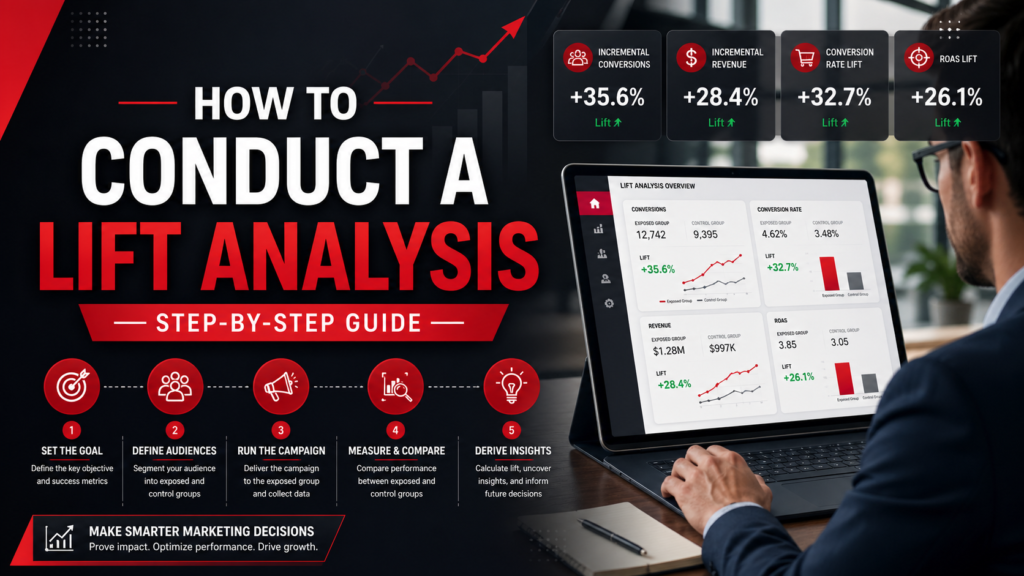
How to Conduct a Lift Analysis — Step-by-Step Guide
Whether you are running a digital campaign or an elevator advertising campaign, here is a practical step-by-step process:
Step 1 — Define Your Campaign Objective Clearly
Before you can measure lift, you need to know what you are trying to lift. Is it brand awareness? Store visits? App downloads? Lead generation? Be specific. “Increase brand awareness in Noida” is better than “improve our brand.”
Step 2 — Identify the Right Metric
Choose one primary metric to track as your lift indicator. For brand campaigns, this is typically aided brand awareness (do you recognise this brand?) or brand consideration. For sales campaigns, it is transactions or revenue. For OOH campaigns, it is often search lift or footfall lift.
Step 3 — Design Your Test and Control Groups
Split your target audience or geography into two groups:
- Test group: Gets exposed to the campaign
- Control group: Does NOT get exposed, but is otherwise identical
For geo-based lift (ideal for elevator advertising), choose two similar residential areas — one where you run ads in lifts, one where you do not.
WhatsApp Now : 972-932-1918
Step 4 — Establish Your Baseline
Before the campaign starts, measure your chosen metric in both groups. This is your baseline. Any changes measured after the campaign started can be compared to this baseline.
Step 5 — Run Your Campaign
Execute the campaign only in the test area/group. Keep everything else constant — do not change pricing, products, or other marketing activity during the measurement window.
Step 6 — Measure Post-Campaign Outcomes
After the campaign ends (or at regular intervals during it), measure your chosen metric in both groups again. The difference in improvement between the test group and control group is your lift.
Step 7 — Calculate Your Lift Score
Lift Formula:
Lift = ((Test Group Result − Baseline) − (Control Group Result − Baseline)) / Control Group Baseline × 100
Or more simply:
Lift % = (Test Group Outcome − Control Group Outcome) / Control Group Outcome × 100
Step 8 — Interpret and Act
Analyse what the lift tells you. Was it statistically significant? Which locations or audience segments showed the highest lift? Use this insight to optimise your next campaign — adjusting placements, creative, frequency, or timing.
WhatsApp Now : 972-932-1918
Key Metrics in Lift Analysis — What to Track and Why
Not all metrics are equal in a lift study. Here are the ones that matter most:
Aided Brand Awareness Lift Measures how many more people recognise your brand after the campaign compared to the control group. A 5–15% lift is strong for a single campaign wave.
Unaided Brand Recall Lift Measures how many people spontaneously name your brand without prompting. Harder to move, but more meaningful. Elevator advertising, with its repeated exposure to the same audience, tends to drive strong unaided recall lift.
Brand Consideration Lift Measures the increase in people who say they would consider buying your brand. This is the bridge between awareness and purchase.
Search Lift Measures the increase in branded search queries (Google searches for your brand name) from your target area during and after the campaign. This is one of the most measurable and reliable indicators of OOH advertising effectiveness.
Purchase Intent Lift Measures the increase in people who say they intend to buy your product. High purchase intent lift is the strongest predictor of actual sales improvement.
Lift Analysis for Elevator Advertising — Why It Works So Well
Here is something most marketing guides miss: elevator advertising is uniquely suited to lift analysis, and the results are often stronger than people expect.
Here is why:
Geographic Precision Elevator ads run in specific buildings and societies. You can choose buildings in one area as your test group and buildings in another area as your control group. The boundary is clean and the exposure is controlled.
Captive Audience = High Recall A person riding an elevator sees your ad for 30–90 seconds, with no scroll button and no distraction. This kind of undivided attention drives higher brand recall than most other ad formats — which means lift studies on elevator campaigns consistently show strong brand recall lift numbers.
Frequency Effect People who live in a building ride the lift multiple times a day — every single day. Over a one-month campaign, a resident may see your ad 50–100 times. This kind of repetition creates deep brand impression, which shows up clearly in lift studies.
Low Clutter Environment In a lift, your ad is the only ad. There is no competitor’s ad next to yours. This clutter-free environment dramatically improves message absorption — and lift results.
WhatsApp Now : 972-932-1918
At Liftup Marketing, we have seen consistent brand awareness lift of 25–40% in residential societies where we run full-building campaigns — far above the industry average for most OOH formats.
Benefits of Running Lift Analysis for Your Campaigns
Whether you use lift analysis for digital, OOH, or elevator advertising — the benefits are clear and significant:
- Proves real ROI — separates what your campaign caused from what happened anyway
- Justifies marketing spend — gives you hard numbers to present to stakeholders
- Identifies best-performing placements — shows you which buildings, areas, or audience segments responded most
- Improves future campaigns — every lift study is a roadmap for the next campaign
- Builds client trust — for agencies like Liftup Marketing, sharing lift results builds long-term advertiser confidence
- Prevents budget waste — stops you from spending money on placements that look effective but aren’t moving any metric
- Enables smarter media mix — shows how different channels work together to drive compounding lift
WhatsApp Now : 972-932-1918
Common Mistakes Marketers Make in Lift Analysis
Even experienced marketers get lift analysis wrong. Here are the most common errors — and how to avoid them:
Mistake 1: Not Establishing a Proper Control Group The most critical error. Without a clean control group, you are measuring correlation, not causation. Make sure your control group is genuinely similar to your test group in all important ways.
Mistake 2: Running the Campaign Across Both Groups This sounds obvious — but it happens. If your control group is accidentally exposed to the campaign (a resident from a non-covered building sees a digital ad for the same brand), the lift measurement is contaminated.
Mistake 3: Measuring Too Soon Brand lift takes time to register. If you measure awareness one day after a campaign ends, you will miss a significant portion of the impact. Give it 2–4 weeks post-campaign before measuring final lift numbers.
Mistake 4: Ignoring Statistical Significance A 3% lift sounds positive. But if your sample size is small, that 3% might be random noise — not a real effect. Always check whether your lift result is statistically significant before drawing conclusions.
Mistake 5: Using Vanity Metrics as Lift Indicators Measuring “reach” or “impressions” as the lift metric defeats the purpose. Lift analysis must measure a genuine business outcome — awareness, recall, consideration, sales, footfall, or search behaviour.
Mistake 6: Running Lift Studies Only Once A single lift study gives you a snapshot. Running lift studies across multiple campaign waves shows trends — which placements consistently deliver lift, which creative drives stronger results, and how lift compounds over time.
Best Practices for Lift Analysis in 2026
Follow these best practices to get the most accurate and useful results:
- Pre-define success — Agree on what “good lift” looks like before the campaign starts, not after
- Use consistent methodology — Compare your lift studies using the same measurement approach each time
- Keep the control group clean — Do not run other campaigns targeting the control area during your lift study window
- Segment your results — Look at lift by building type, audience profile, or location to find your highest-performing pockets
- Combine lift with behavioural data — Pair lift study results with search trend data from Google Trends for your brand in the target geography
- Share results with all stakeholders — Lift analysis is most powerful when it informs budget decisions at the senior level
- Run lift studies on every significant campaign — Make it a habit, not an exception
WhatsApp Now : 972-932-1918
Frequently Asked Questions (FAQs)
1. What is lift analysis in simple terms?
Lift analysis measures the additional impact your marketing campaign created — beyond what would have happened without the campaign. It compares a group exposed to the campaign against a similar group that was not, and the difference in outcomes is the lift. It is the clearest way to prove whether a campaign actually worked.
2. How is lift analysis different from regular campaign reporting?
Regular campaign reporting shows you what happened — impressions, clicks, reach, conversions. Lift analysis shows you what your campaign caused. For example, sales might have gone up during your campaign — but lift analysis tells you how much of that increase was because of the campaign versus other factors.
3. What is a good lift percentage for a brand awareness campaign?
It depends on the channel and campaign type. For elevator advertising, a brand awareness lift of 20–40% is achievable given the captive audience and high-frequency exposure. For digital display ads, even a 5–10% lift is considered meaningful. Always compare your lift against a baseline from a previous campaign or industry benchmark.
4. Can lift analysis be done for offline advertising like elevator ads?
Yes — and it works very well for elevator advertising specifically. Because lift ads run in defined buildings and localities, you can use geographic test and control groups cleanly. Brand recall lift and search lift (measured via Google Trends for the specific pincode) are the most practical metrics for elevator campaign lift studies.
5. How long does a lift analysis take?
The measurement window typically runs for the duration of the campaign plus 2–4 weeks post-campaign. For a 30-day elevator advertising campaign, a full lift study takes about 6–8 weeks in total — including pre-campaign baseline measurement, the campaign period, and post-campaign measurement.
6. What is the difference between brand lift and sales lift?
Brand lift measures changes in consumer perception — awareness, recall, consideration, and purchase intent. Sales lift measures direct revenue or transaction increases. Brand lift campaigns (like elevator advertising) typically show strong brand lift, which then influences sales lift over time as awareness converts to purchase intent.
7. How does Liftup Marketing use lift analysis for its clients?
Liftup Marketing uses geo-based lift testing — running campaigns in specific residential societies and comparing awareness, recall, and search metrics against similar societies that were not covered. We also track QR code scan rates, branded search volume trends, and post-campaign surveying to give clients a full picture of campaign impact.
8. Is lift analysis only for large brands with big budgets?
Not at all. Even small and medium-sized businesses can run basic lift studies using simple pre-post measurement within their target geography. For elevator advertising campaigns, a simple brand recall survey among building residents before and after the campaign can give meaningful lift data at very low cost.
WhatsApp Now : 972-932-1918
Conclusion — Start Measuring What Actually Matters
Marketing in 2026 is not just about being seen. It is about proving that being seen actually changed something — a mind, a preference, a purchase decision.
Lift analysis in 2026 is the tool that makes that proof possible. It separates genuine campaign impact from the background noise of a busy market. It gives marketers the confidence to invest, scale, and optimise — based on real evidence rather than assumptions.
For brands running elevator advertising campaigns, this is particularly powerful. The captive audience, the geographic precision, and the high-frequency exposure of lift advertising makes it one of the most measurable formats in the OOH world — when you apply the right lift measurement framework.
At Liftup Marketing, we believe every rupee you spend on advertising should be accountable. That is why we work with our clients not just to place ads in lifts — but to measure the genuine brand lift those ads create, campaign after campaign.
Understanding lift analysis is the first step. Acting on it is what separates great marketers from average ones.
WhatsApp Now : 972-932-1918
Ready to Run a Measurable Elevator Advertising Campaign?
If you want to advertise in residential lifts across Delhi NCR — and actually prove the impact — Liftup Marketing is your partner.
We operate across Indirapuram, Vaishali, Vasundhara, Noida, and surrounding areas. We offer complete elevator advertising solutions — placement, creative support, campaign management, and lift analysis reporting.
Let your brand go up every time the elevator does.
Get in Touch With Liftup Marketing Today–branding@liftupmarketing.in –972-932-1918