
Introduction
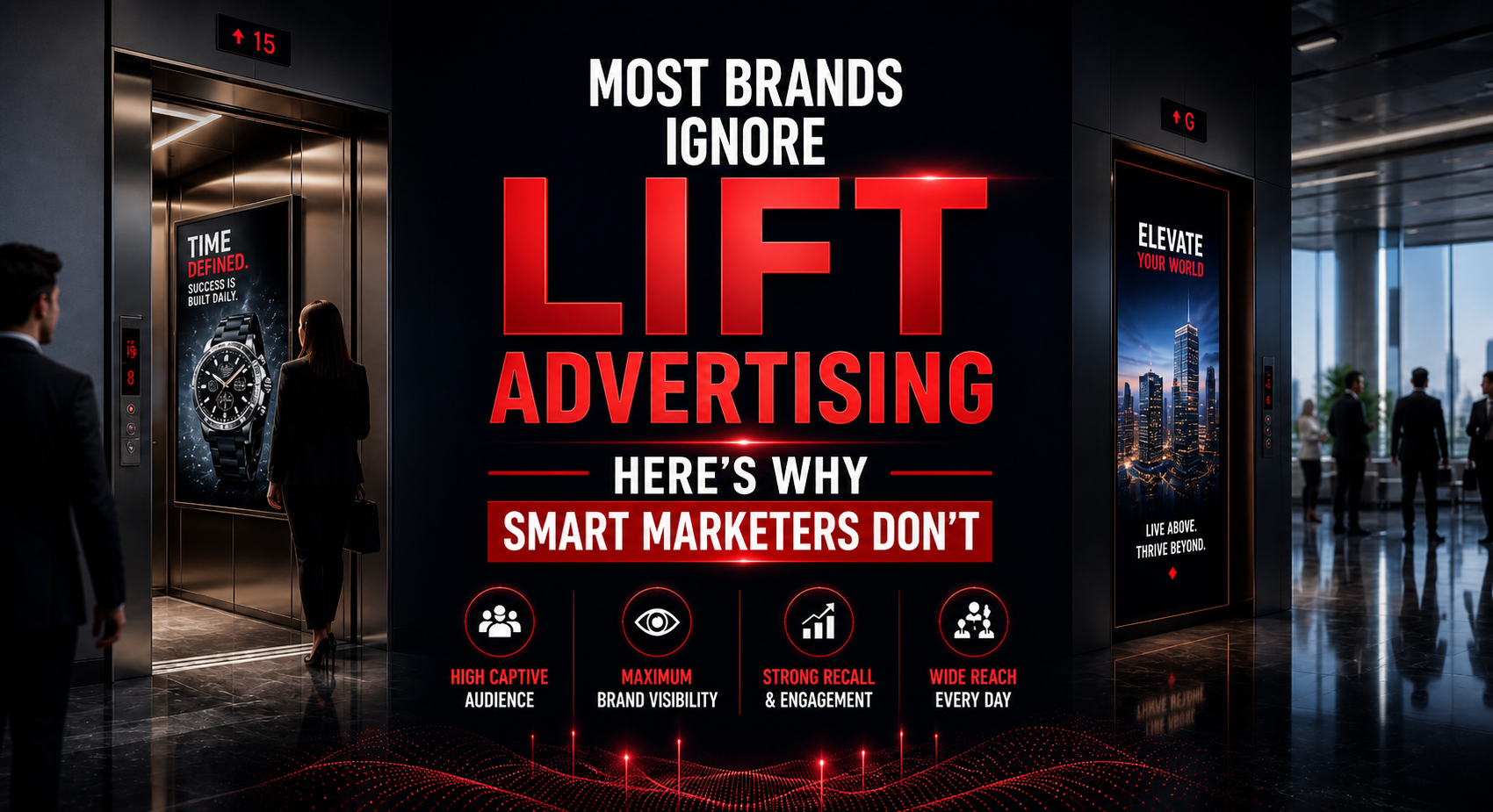
Every marketer is chasing digital ads, social media placements, and influencer deals. Meanwhile, one of the most powerful advertising channels sits quietly in office buildings, malls, and residential towers — completely overlooked. Lift advertising (also called elevator advertising) has been hiding in plain sight for years, and most brands walk right past it.
That is a big mistake. Smart marketers know something others don’t: the people riding elevators every single day are a captive, attentive audience. There is no scroll button. There is no skip option. For those 30 to 60 seconds inside a lift, your message has their full attention.
In this article, we break down why most brands ignore lift advertising, why that is costing them, and exactly how forward-thinking marketers are using elevator ads to build recall, reach premium audiences, and get results.
WhatsApp Now : 972-932-1918
What Is Lift Advertising?
Lift advertising refers to placing promotional content inside or outside elevators. This includes printed posters, digital screens, floor graphics, mirror decals, and interactive displays placed within elevator cabins or at lift lobbies.
It is a form of Out-of-Home (OOH) advertising — but far more targeted and intimate than a roadside billboard.
You will find elevator advertising in:
- Corporate office buildings and IT parks
- Shopping malls and retail centres
- Residential apartment complexes
- Hotels and serviced apartments
- Hospitals and medical centres
- Airports and transit hubs
The key thing that makes lift advertising different from other OOH formats is the enclosed environment. A person inside a lift has nowhere else to look. They cannot walk away. They are not distracted by traffic or noise. That moment of undivided attention is rare — and incredibly valuable.
Why Most Brands Ignore Lift Advertising
Let’s be honest about why this channel gets skipped.
- It feels too niche. Most marketers think elevator ads are only for luxury brands targeting high-income audiences. That assumption is outdated. Lifts exist everywhere — from budget apartments to premium towers.
- It is not digital-first. In a world obsessed with click-through rates and impressions, a physical ad inside a lift can feel “unmeasurable.” But that perception is changing fast with digital lift screens and QR code integration.
- Limited awareness among media buyers. Many agencies simply don’t pitch it. If it’s not on their standard rate card, it often doesn’t get discussed.
- Misconception about reach. Marketers assume they need mass reach — highway billboards, prime-time TV. But reach without relevance is wasted spend. Lift advertising offers precision reach that traditional OOH rarely delivers.
The brands that figure this out early gain a significant advantage.
Why Smart Marketers Take Lift Advertising Seriously
WhatsApp Now : 972-932-1918
The Captive Audience Advantage
There is no ad format quite like one that physically surrounds your viewer. When someone steps into a lift, they are in an enclosed space for anywhere between 20 and 90 seconds. They are not multitasking. They are not half-watching a video. They are just… there.
That level of undistracted exposure is almost impossible to achieve in digital advertising. The average person sees 4,000 to 10,000 ads a day online. Most get ignored. But a well-placed lift ad in the right building? It gets noticed — every single day, multiple times a day, by the same person.
That repetition builds top-of-mind recall in a way that a single digital impression never can.
Premium Audience Targeting
Location is everything in lift advertising. If you place ads in:
- A corporate office tower — you reach working professionals, decision-makers, and business owners
- A luxury residential complex — you reach high-net-worth households
- A premium mall — you reach active shoppers with purchase intent
- A hospital — you reach patients, caregivers, and medical staff
This makes lift advertising one of the most precise targeting tools available in the physical world. You are not just buying impressions — you are buying the right impressions.
High Frequency, Low Cost Per Impact
Unlike digital ads where you pay for every click or view, lift advertising works on a fixed placement model. Once your creative is up, it reaches everyone who uses that lift — at no additional cost per person.
In high-traffic buildings, a single elevator can carry 200 to 500 people per day. Over a month, that is thousands of targeted exposures from one placement.
The cost per contact is remarkably low when you calculate it this way.
WhatsApp Now : 972-932-1918
Lift Advertising vs Other OOH Formats — A Comparison
| Format | Audience Attention | Targeting Precision | Avg. Daily Reach | Clutter Level | Cost Efficiency |
| Lift / Elevator Ad | Very High (captive) | Very High (location-based) | 200–500 per lift | Very Low | High |
| Billboard / Hoarding | Low (passing glance) | Low (geographic only) | High but unfocused | High | Medium |
| Metro / Bus Shelter | Medium | Medium | High | Medium | Medium |
| Mall Kiosk / Display | Medium | Medium–High | Medium | High | Medium |
| Digital Display Ad | Very Low (scrolled past) | High (data-based) | Very High | Extremely High | Variable |
The data tells a clear story. Lift advertising consistently outperforms other formats on the two factors that matter most: attention and targeting precision.
How to Run a Successful Lift Advertising Campaign
WhatsApp Now : 972-932-1918
Step 1: Define Your Target Audience Clearly
Before you book a single placement, know exactly who you want to reach. Are they working professionals? Families in gated communities? Shoppers? This will determine which buildings and locations make sense.
Step 2: Choose the Right Buildings and Locations
Work with a lift media vendor or OOH agency to map out buildings that match your audience profile. Look at footfall data, building type, and neighbourhood demographics.
Step 3: Decide on Your Ad Format
Lift advertising offers several creative options:
- Static poster panels — cost-effective, high visibility
- Digital screens — allows video content and rotating ads
- Mirror decals — hard to miss, eye-catching
- Floor graphics — unusual and memorable
- QR code integration — bridges offline and online, makes it trackable
Step 4: Design for the Space
A lift is a small, enclosed space. Your creative needs to work differently here than it would on a billboard. Keep the message short. Use bold visuals. Make sure the key information is readable in under 5 seconds.
Step 5: Add a Trackable Element
Use a QR code, a dedicated landing page URL, or a unique promo code so you can measure how many people took action after seeing your lift ad.
Step 6: Run the Campaign and Monitor Results
Book a minimum campaign period of 4 to 8 weeks for meaningful results. Track brand searches, QR scans, promo code redemptions, and any uplift in web traffic from the target locality.
WhatsApp Now : 972-932-1918
Best Practices for Lift Advertising
- Keep copy minimal. One headline, one key message, one call to action. That is all you need.
- Use high-contrast visuals. Lift lighting can be harsh. Make sure your creative pops under artificial light.
- Match your building to your brand. A luxury skincare brand should be in premium towers, not budget apartments. Context matters.
- Refresh creatives regularly. The same people ride the same lift every day. Change your ad every 4–6 weeks to avoid creative fatigue.
- Use digital screens where possible. Digital lift screens allow dynamic content, time-of-day targeting, and easy creative updates.
- Always include a call to action. Even a simple “Scan to learn more” or “Visit us at [website]” turns a passive impression into an active response.
Common Mistakes Brands Make With Lift Advertising
- Overcrowding the creative with information. A lift ad is not a brochure. If you try to cram your entire product catalogue onto one panel, nobody will read any of it.
- Ignoring the location fit. Placing a budget brand’s ad in a luxury building — or a premium brand’s ad in a low-footfall location — wastes budget and creates brand dissonance.
- Running too short a campaign. Lift advertising builds recall through repetition. A one-week campaign will rarely produce measurable brand impact. Commit to at least a month.
- No tracking mechanism. Without a QR code, unique URL, or promo code, you have no way to attribute results. Always build in a way to measure response.
- Not briefing the creative team on the format. Many designers treat a lift panel like a standard print ad. It is not. The enclosed space, proximity to the viewer, and short dwell time all require a different creative approach.
- “Complete Guide to Out-of-Home (OOH) Advertising in India” — Link from the section explaining what lift advertising is and how it fits into OOH.
- “How to Measure ROI on Offline Advertising Campaigns” — Link from the step on adding trackable elements and monitoring results.
WhatsApp Now : 972-932-1918
Frequently Asked Questions (FAQs)
1. What is lift advertising and how does it work?
Lift advertising involves placing promotional materials — posters, digital screens, decals, or QR codes — inside or around elevators in high-traffic buildings. It works by reaching a captive audience during the 30–90 seconds they spend inside the lift, with no distractions and no way to skip the ad.
2. Is lift advertising effective for small businesses?
Yes. Lift advertising is actually ideal for local and small businesses because you can target a very specific neighbourhood, building type, or audience. A dental clinic, real estate developer, or premium café can place ads in nearby residential or office buildings and reach exactly the right people at a fraction of the cost of mass media.
3. How much does lift advertising cost in India?
Costs vary depending on the city, building type, number of lifts, and ad format. Static panels in residential buildings typically start from ₹3,000–₹8,000 per lift per month. Digital screens in premium office buildings or malls can range from ₹15,000–₹50,000 per month. The cost per actual contact, however, is very low given daily repetition.
4. How do I measure the ROI of a lift advertising campaign?
Use trackable elements like QR codes leading to a unique landing page, dedicated promo codes, or a specific phone number. You can also track increases in local branded search volume, foot traffic to your store, or web traffic from the target locality during the campaign period.
5. What types of brands benefit most from lift advertising?
Lift advertising works well for real estate developers, premium consumer brands, local service businesses (clinics, salons, restaurants), financial services, educational institutions, and e-commerce brands targeting specific demographics. Essentially, any brand that benefits from precise local or audience targeting will find elevator advertising valuable.
WhatsApp Now : 972-932-1918
Conclusion
Most brands are not ignoring lift advertising because it does not work. They are ignoring it because they simply have not stopped to think about it carefully. That is where the opportunity lies.
Lift advertising gives you something no social media platform can: a captive, undistracted audience in a controlled environment, repeated exposure to the same people every single day, and precise targeting based on the buildings and neighbourhoods you choose.
Smart marketers already know this. The brands winning in their local markets, building strong recall among high-value audiences, and getting more from their offline spend — they have figured out the power of the elevator.
The lift doors are open. It is time to step in.
WhatsApp Now : 972-932-1918
Ready to Launch a Lift Advertising Campaign?
Whether you are a brand looking to reach premium audiences or a marketer building a high-impact OOH strategy, lift advertising deserves a place in your media plan.
Start by identifying the top 10 buildings where your ideal customer lives or works — and go from there.
Want expert guidance on planning your next campaign? Reach out today and let’s talk strategy.