
A gym owner in Indirapuram once told us something that stuck. He’d spent close to ₹40,000 on Instagram ads in a single month. Reach was great. Likes looked great. Footfall? Eight new walk-ins. Eight.
Meanwhile, the salon two floors below his office was packed every weekend — and the owner had never touched a paid digital campaign in her life.local marketing strategies
So what was she doing differently? She was being seen by the right people, repeatedly, in a place where they actually had time to notice her. That’s the whole game. And it’s exactly what the best local marketing strategies are built on.
We’re LiftUp Marketing — a Delhi NCR elevator advertising agency that’s been running hyperlocal marketing campaigns inside residential and commercial lifts since 2017. We’ve placed brands in front of captive society audiences across Indirapuram, Vaishali, Vasundhara, Noida and the wider NCR belt. This post is everything we’ve learned about getting local businesses noticed — written for owners, not for an algorithm.
Key Takeaway
Hyperlocal marketing means reaching customers in a tightly defined geographic radius — your actual catchment area — through high-frequency, hard-to-ignore touchpoints. For local businesses like gyms, salons, clinics and real estate, the most effective offline channel is residential lift advertising, because it delivers repeated, captive exposure to the exact households that live within 1–3 km of your storefront. Digital ads get scrolled past in under two seconds. A lift poster gets 20–60 seconds of undivided attention, several times a day, from the same people.
If you read nothing else, read that. The rest of this is the why and the how.
What is a hyperlocal marketing strategy?
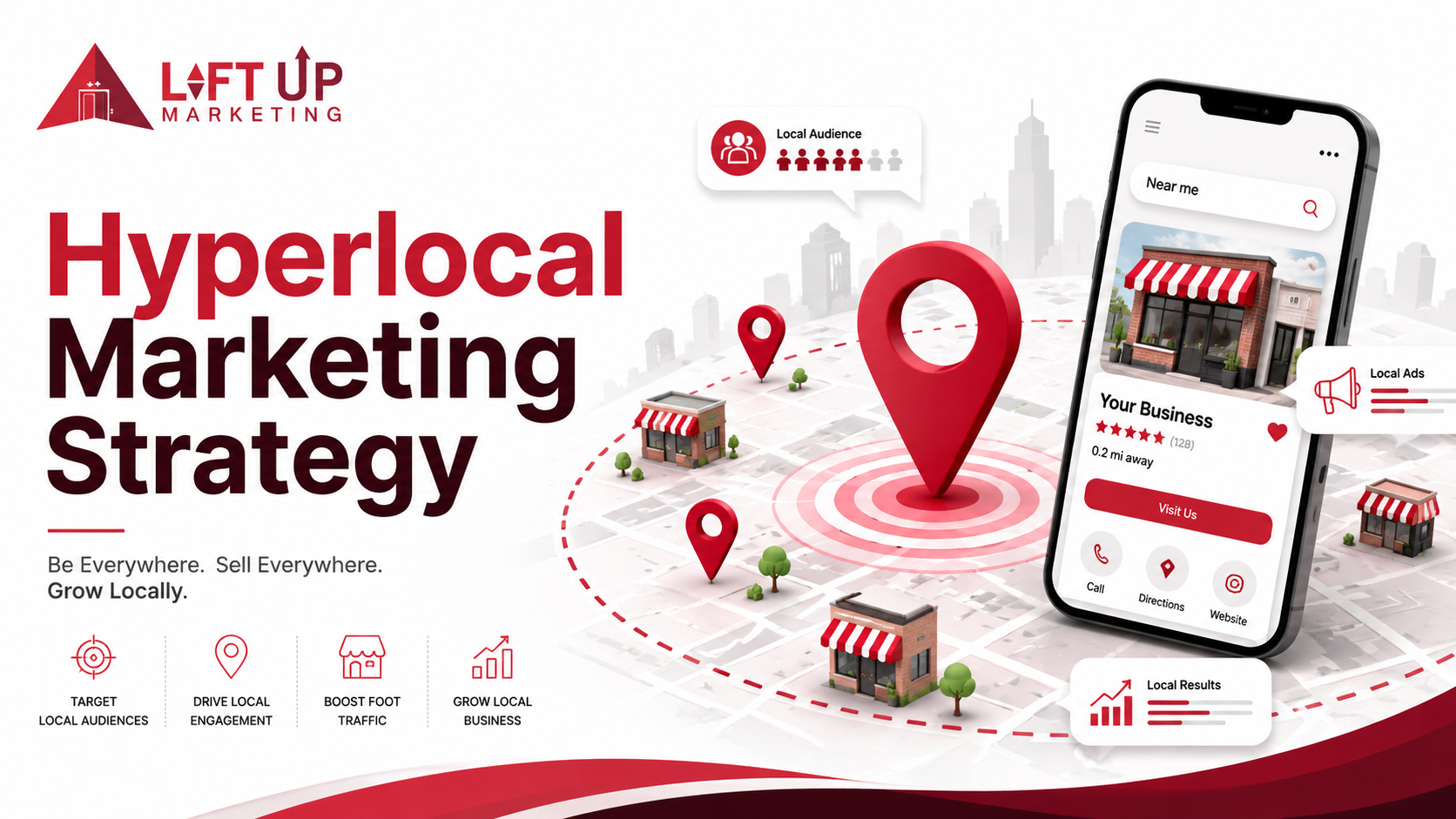
A hyperlocal marketing strategy is a plan to win customers within a small, specific geographic area — usually the few kilometres around your business — instead of broadcasting to a whole city. It combines geo-targeted advertising, community presence, and high-frequency offline touchpoints to build recognition with the people most likely to actually visit you.
The logic is brutally simple. A salon in Vaishali doesn’t need 50,000 strangers across Delhi to know its name. It needs the 2,000 households within walking-and-driving distance to know it, trust it, and think of it first. That’s it.
And here’s where most owners get it wrong. They chase reach when they should be chasing relevance and frequency. A million impressions across NCR is worth less to a neighbourhood clinic than 3,000 well-targeted impressions inside the towers their patients actually live in.
Why digital-only local marketing is quietly failing small businesses
Let’s talk about the elephant in the feed.
The average urban Indian is now exposed to somewhere between 6,000 and 10,000 ad messages a day — a figure marketing researchers have been revising upward for a decade. Your brain physically cannot process that. So it does the only sane thing: it filters almost all of it out.
This filtering has a name in marketing science. It’s called banner blindness — the well-documented tendency for people to subconsciously ignore anything that looks like an ad. It’s why the average display banner clickthrough rate sits around 0.05%. Read that again. Out of 2,000 people who “see” your banner, roughly one clicks.
Then there’s ad fatigue: the point where your audience has seen your creative so many times that performance collapses and your cost-per-result climbs. On Meta, marketers often watch results decay within 5 to 10 days on a tight local audience, simply because the pool is small and the same people keep seeing it until they tune out.
Digital didn’t make attention cheaper. It made it scarcer. The scroll is a defence mechanism, and your ad is what people are defending themselves against.
None of this means abandon digital. It means stop treating it as your only play. The smartest offline marketing ideas for small business work precisely because they reach people in the moments when their guard is down and their phone isn’t.
The captive audience effect: why lifts beat almost every other local channel
Here’s the strategic insight most digital blogs will never tell you, because they don’t sell it.
When someone steps into a lift, they enter what behavioural marketers call a captive environment. There’s no scroll. No “skip ad in 5.” No swiping away. For 20 to 60 seconds, they’re standing still in a small, quiet box with nothing to look at — except your poster.
This is the captive audience effect, and it’s the single most underrated principle in local advertising. Attention that’s impossible to avoid converts at a completely different rate than attention you have to fight for.
Now layer on frequency. The classic marketing “Rule of 7” says a prospect typically needs around seven exposures to a brand before they act. On digital, hitting frequency seven is expensive and triggers fatigue. Inside a lift? A working professional rides the same elevator four to six times a day — morning, lunch, evening, the grocery run. You hit the Rule of 7 in under two days, naturally, without paying per impression.
That’s the quiet genius of residential lift advertising: built-in repetition to a fixed, hyperlocal audience, in a captive setting, at a fraction of digital’s effective cost-per-engaged-view.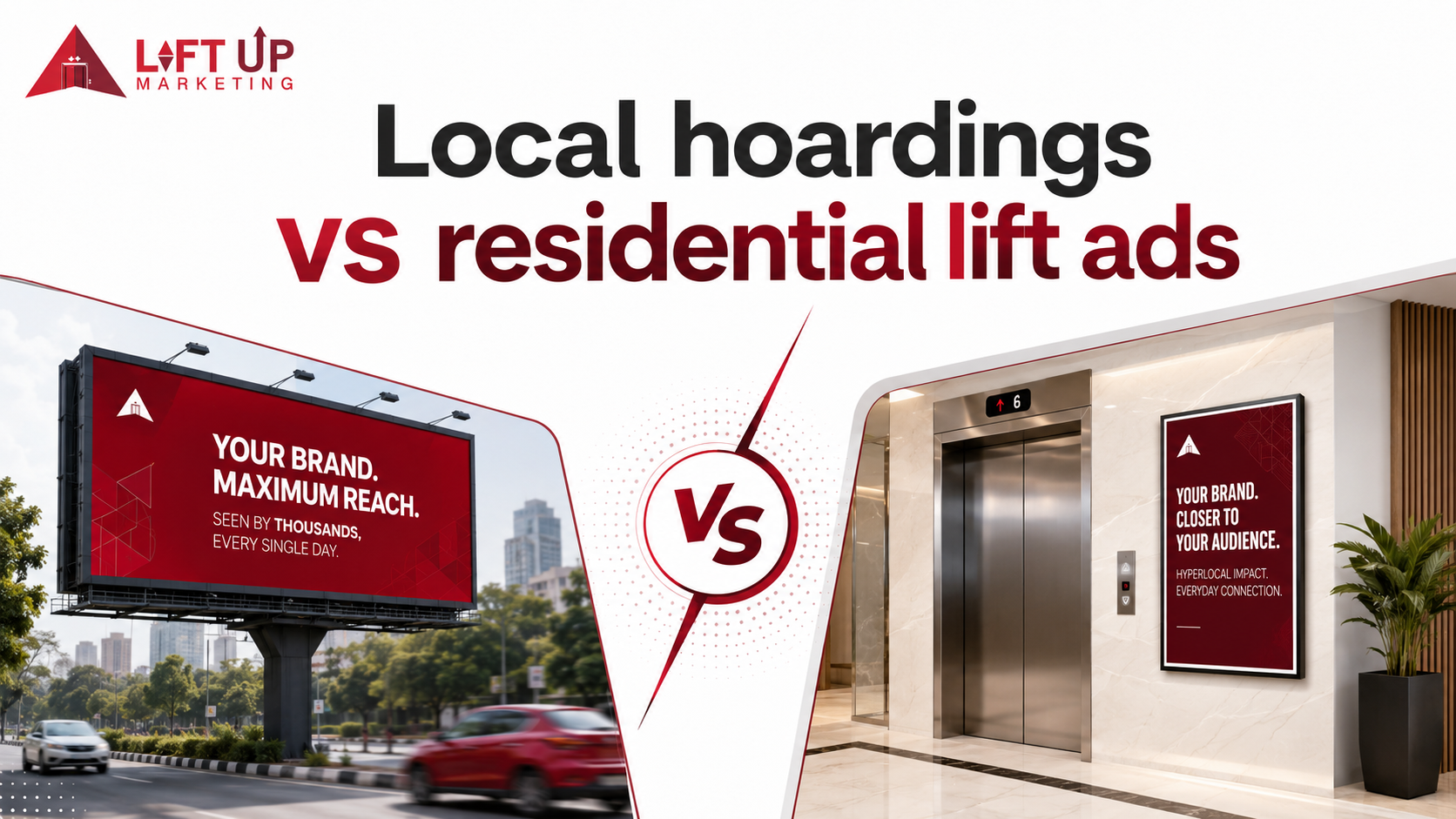
Hyperlocal marketing examples: what this looks like in the real world
Theory is nice. Here’s how it actually plays out for the businesses we work with.
A gym doesn’t advertise to a city. It books the 30 towers within a 2 km radius — the people who’ll realistically drive over before or after work. A poster with a “₹0 joining fee for residents of [Society Name]” promo code turns a generic ad into a neighbour-to-neighbour offer. We’ve seen these convert because residents feel like the gym is theirs.
A real estate developer launching a new project uses lifts in nearby premium societies to reach exactly the demographic upgrading their home — captive, high-income, family-stage buyers who are already living the apartment lifestyle.
A dental or skin clinic runs a poster that lives on the wall of every lift in the cluster of buildings it serves. When a toothache hits at 9 PM, the brain doesn’t Google “best dentist.” It recalls the name it’s seen forty times that week on the way down to the parking. That’s recency and mental availability doing the work.
A salon ties a lift campaign to a festival or a Sunday slot — “Diwali ready in 90 minutes, walk-ins welcome, Tower B residents get 15% off.” Hyperlocal, time-bound, and impossible to ignore on the morning ride down.
The thread running through all of these? Proximity plus repetition plus a reason to act. That’s how to attract local customers without burning budget on people who’ll never visit.
Local hoardings vs residential lift ads: a straight comparison
Owners often ask us how lift advertising stacks up against the local hoarding or the newspaper insert. So here it is, plainly.
| Factor | Local Hoarding / Billboard | Newspaper Insert | Residential Lift Ads (LiftUp) |
|---|---|---|---|
| Attention quality | Glanced at while driving (1–2 sec) | Often binned unread | Captive 20–60 sec, undivided |
| Frequency per person | Once, if their route passes it | Once | 4–6 times a day, same people |
| Geo-precision | Whole road / area | Whole pincode | Building & society-level targeting |
| Audience match | Anyone passing | Print subscribers only | Verified residents of chosen towers |
| Ad fatigue risk | Low but low impact | High | Low — fresh context each ride |
| Trackability | Very hard | Hard | Promo codes per society = measurable ROI |
| Cost efficiency (CPM) | High for premium spots | Declining reach | Low effective cost per engaged view |
The hoarding wins on raw size. The lift wins on everything that actually moves a local customer to act: frequency, precision, attention, and measurability.
How geo-targeted advertising works when it’s offline
People assume geo-targeted advertising is a digital-only thing — a setting in Google or Meta. It isn’t. Lift advertising is geo-targeting in its purest, most literal form.
You’re not targeting an interest profile that a platform guessed at. You’re targeting a physical address. When we build a campaign, you tell us your catchment — say, a 2.5 km radius around your clinic in Vasundhara — and we map it to actual societies, tower by tower. You choose the buildings. You reach the households living in them. No wastage on people who’ll never realistically travel to you.
This is also where measurement comes in, which is the objection we hear most. “Offline can’t be tracked.” Wrong. We assign a unique promo code per society on the poster. When a customer redeems it, you know precisely which building drove the sale. Over a campaign, you can see which towers convert best and double down — the same optimisation loop digital marketers love, applied to the physical world.
Building your own hyperlocal marketing plan (the practical framework)
If you’re putting together local business promotion ideas, here’s the sequence we’d actually recommend, in order.
Start with your catchment, not your creative. Draw the realistic radius people will travel from to reach you — for most neighbourhood businesses that’s 1–3 km. Everything else follows from this.
Map the households inside it. Identify the residential clusters, the footfall, the demographic. A premium tower suits real estate and clinics; a dense mid-income society might be perfect for a gym or salon.
Pick a channel with frequency built in. A one-time hoarding can’t compete with a placement people see five times a day. This is where lift advertising earns its place.
Give them a reason that’s local. Generic offers feel like spam. “Residents of [Society] get…” feels like a neighbour helping a neighbour. The second one converts.
Make it measurable. Promo codes, dedicated WhatsApp lines, society-specific landing pages — bake tracking in from day one so you’re not guessing.
Then add digital as the echo. Once the offline impression has planted the name, retargeting and local search close the loop. Offline builds the familiarity; digital catches the intent. That combination beats either one alone.
Frequently Asked Questions
What are the best local marketing strategies for small businesses?
The most effective local marketing strategies combine tight geo-targeting with high-frequency, hard-to-skip touchpoints. For neighbourhood businesses, residential lift advertising, local promo-code offers, Google Business Profile optimisation, and community-event presence consistently outperform broad digital campaigns — because they reach the specific households within your catchment area, repeatedly.
How does lift advertising help attract local customers?
Lift advertising reaches residents inside a captive environment where they have nothing to do but read your poster for 20–60 seconds. Because the same people ride the lift four to six times a day, your brand builds recognition fast through natural repetition. This frequency plus proximity is what turns nearby residents into walk-in customers.
Is offline marketing still effective in 2026?
Yes — arguably more than ever. As digital ad fatigue and banner blindness reduce online ad performance, well-placed offline channels stand out precisely because they’re harder to ignore. The strongest results today come from pairing offline visibility (like lift ads) with digital retargeting, so familiarity and intent reinforce each other.
How much area can a hyperlocal lift campaign cover?
A campaign can be as tight as a single society or expanded across an entire cluster of towers within your catchment radius. At LiftUp Marketing, you select the exact buildings — usually within 1–3 km of your business — so your budget only reaches households likely to actually visit you.
Can I measure the ROI of elevator advertising?
You can. We assign a unique promo code to each society in your campaign, so every redemption tells you exactly which building drove the customer. Over time you can see which towers perform best and reallocate spend toward them — making lift advertising one of the more measurable offline channels available.
Which businesses benefit most from residential lift ads?
Gyms, salons, clinics, dental and skin practices, real estate developers, restaurants, tuition centres, and any service-led local business benefit most — essentially anyone whose customers come from the surrounding residential area rather than the whole city.
Ready to reach the households that actually become customers?
You’ve now got the strategy. The missing piece is the map — which societies, in your radius, are worth your budget.
That’s exactly what we’ll build for you. Tell us where your business is, and we’ll prepare a customised society list showing the residential towers in your catchment area, the resident profile in each, and a campaign plan designed to put your brand in front of them several times a day.
No guesswork, no wasted reach — just the right neighbours seeing your name on every ride.
Get your free customised society list and consultation from LiftUp Marketing.
Call/WhatsApp: +91 97293 21918
Email: branding@liftupmarketing.in Or see exactly how lift advertising works and request a proposal here.
Your future customers are already living a few hundred metres away. Let’s make sure they know your name before your competitor does.