
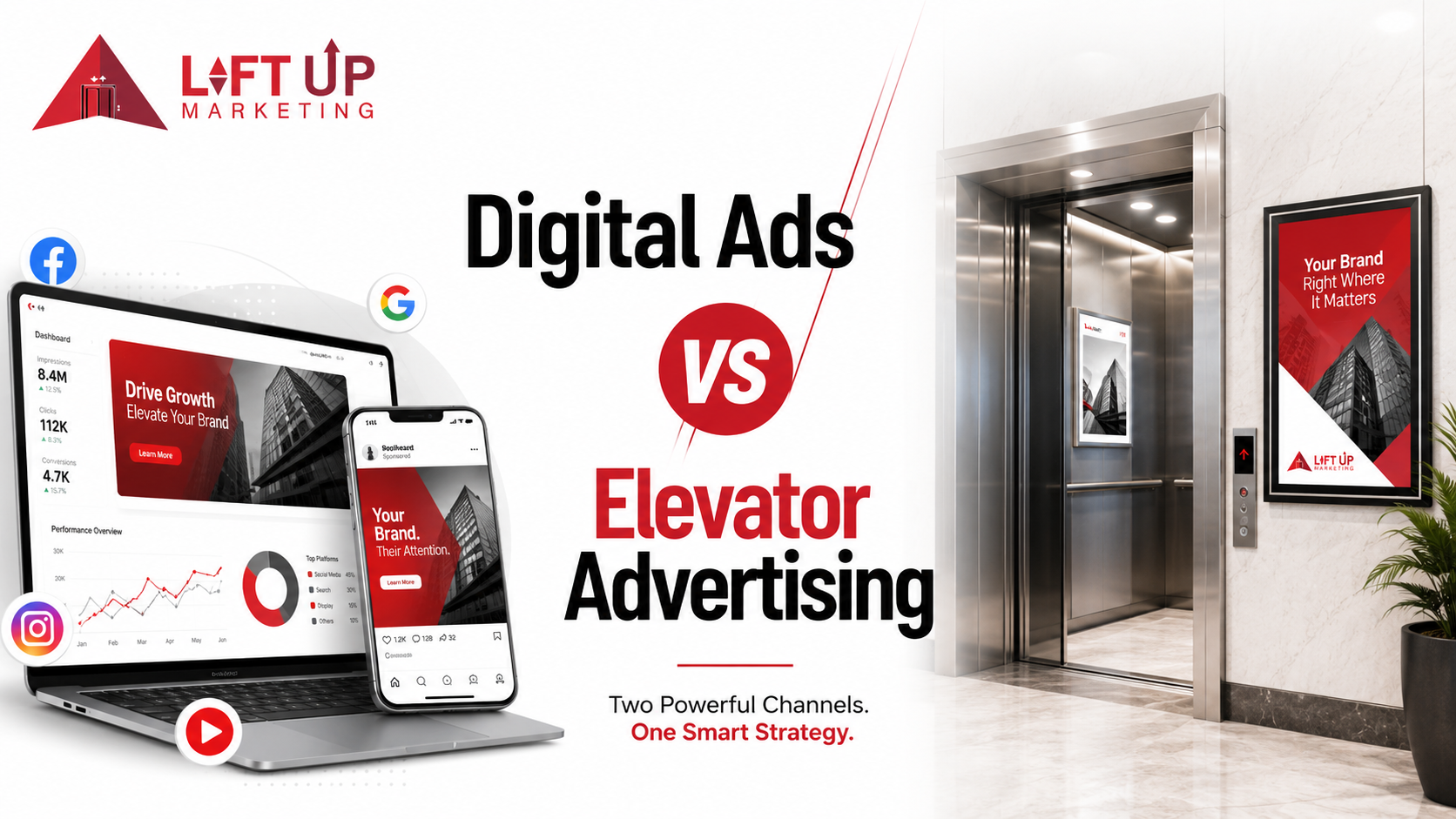
Digital ads face massive skip rates, banner blindness, and rising CPCs. Elevator advertising — a form of captive audience marketing — delivers your message to a confined, distraction-free audience for 30–90 seconds with near-zero skip potential. For local brands, housing society lift ads offer hyper-targeted reach at a fraction of digital costs. This post breaks down exactly why, with data, comparisons, and strategic insight.
Let’s skip the usual preamble. You already know digital marketing exists. You’ve run Google Ads, boosted Instagram posts, maybe even tried programmatic display. And you’ve probably noticed something: the returns are getting harder to justify.
You’re not imagining it. The digital advertising ecosystem is dealing with a structural attention crisis — and unless you’re a D2C brand with a ₹50L monthly ad budget, it’s getting increasingly difficult for local and regional businesses to cut through the noise online.
This post isn’t about abandoning digital. It’s about understanding where your offline marketing dollars can work significantly harder — specifically through elevator advertising, one of the most underestimated yet psychologically powerful formats in the captive audience marketing playbook.
The Real Problem with Digital Marketing Right Now
Ad Fatigue Is No Longer Anecdotal — It’s Measurable
The average person is now exposed to somewhere between 6,000 and 10,000 ads per day across digital surfaces. That number has more than doubled in a decade. The human brain, naturally wired to filter irrelevant stimuli, has responded exactly the way you’d expect: by tuning most of it out.
Consider some hard numbers:
- Display ad click-through rates (CTR) have declined to an average of 0.1% globally, meaning 999 out of every 1,000 people who see your banner ad do nothing with it.
- 63% of users say they find online ads “annoying and intrusive” (HubSpot, State of Marketing Report).
- Ad-blocking software usage has grown by over 30% year-on-year in urban Indian markets, particularly among the 25–45 demographic — the exact audience most B2B and premium B2C brands want to reach.
- The average skip time on YouTube pre-roll ads is 5.5 seconds — and research shows the majority of brand recall from those ads is near zero unless the ad is extraordinary.
“Digital channels are increasingly efficient at distributing ads and increasingly ineffective at generating genuine attention. The medium has matured. The audience has adapted.” — This is the central tension every performance marketer is grappling with today.
The Disadvantages of Digital Marketing That Nobody Talks About in Pitch Decks
The sales pitch for digital always leads with targeting precision and measurability. Fair enough — those are real advantages. But the full picture includes:
Rising cost-per-click (CPC) with falling conversion rates. Google Ads CPCs in competitive Indian local markets (real estate, education, healthcare, FMCG) have risen 40–70% over the last three years. You’re paying more to reach an audience that’s clicking less and converting even less.
Zero dwell time. A Facebook or Instagram ad gets approximately 1.7 seconds of visual attention before the thumb scrolls past. That’s the entire window for brand recognition, message delivery, and intent generation. It’s physiologically insufficient for complex brand narratives.
The fraud problem. Globally, ad fraud accounts for nearly $100 billion in wasted ad spend annually. Bots, click farms, and inflated impression numbers mean a portion of every digital campaign budget goes nowhere.
Context collapse. Digital ads appear next to news about geopolitical crises, celebrity gossip, memes, and personal content. The emotional context is chaotic. Your premium apartment project appears between a recipe video and a political debate. Brand associations matter — and digital gives you very little control over yours.
What Is Captive Audience Marketing — And Why It Changes the Equation
Captive audience marketing is a strategic approach that places your brand message in front of an audience that has no immediate means of avoidance. Unlike digital environments where the user controls the experience entirely, captive placements create enforced yet non-intrusive exposure windows.
Classic examples include: in-flight advertising, waiting room displays, cinema pre-show ads — and elevator advertising.
The key psychological mechanism here is called passive absorption: when a person cannot scroll away, skip, or otherwise escape, their brain shifts into a low-resistance receptive mode. They’re not necessarily “engaged” in the way a person reading a compelling article is — but they are present, calm, and mildly curious. That’s a neurologically very different state than the active-scroll defensive mode most people are in when consuming social media.
Research in environmental psychology suggests that captive exposure in low-stimulation environments (like elevators) produces higher unaided brand recall than equivalent-duration digital ad exposure by a factor of 2–4x.
This is the core reason elevator advertising works — and works consistently.
Elevator Advertising: The Mechanics of Why It Holds Attention
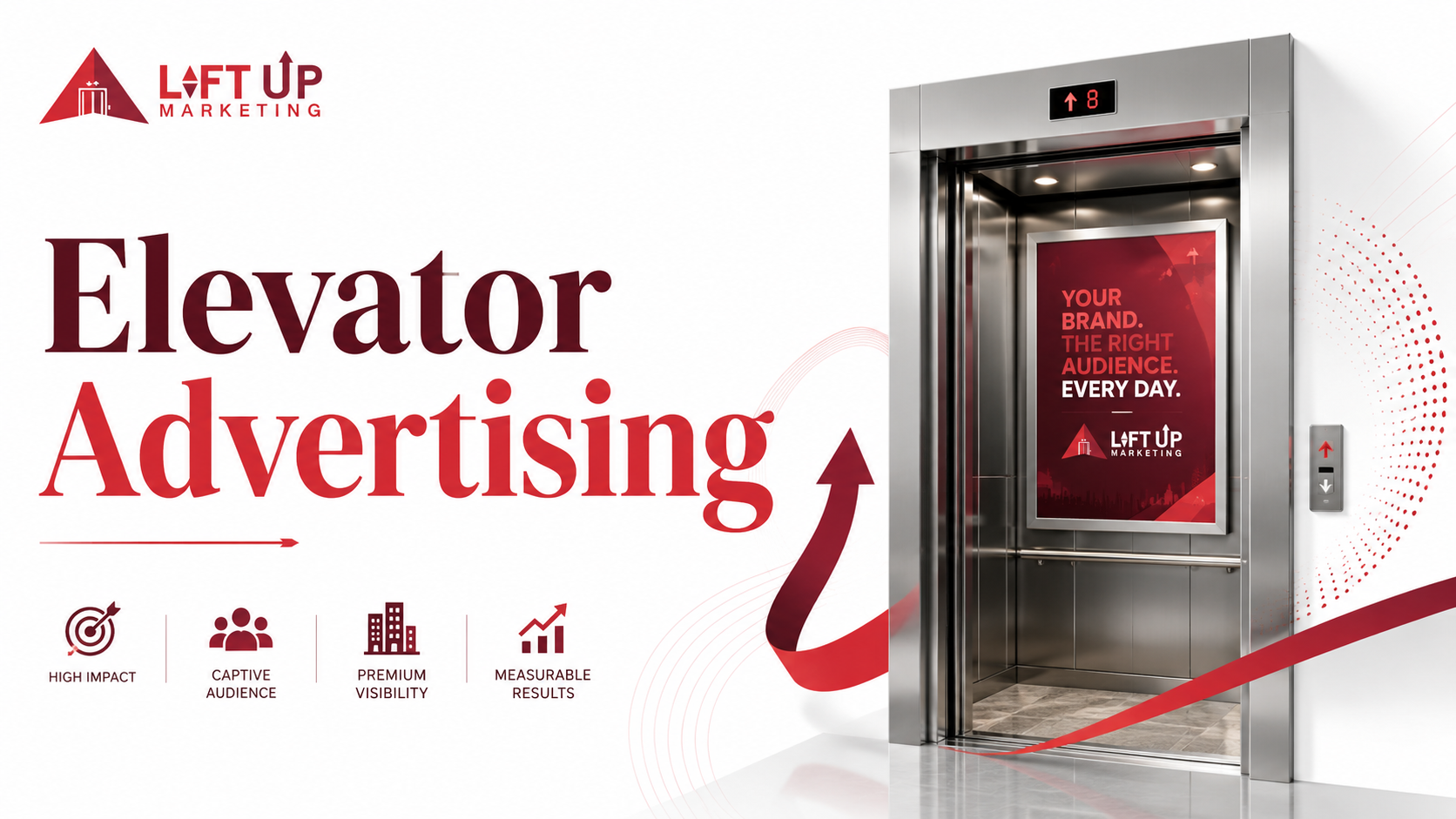
The 30–90 Second Window That Digital Can’t Buy
An elevator ride in a mid-to-high-rise residential or commercial building lasts between 30 and 90 seconds on average. During that window, the person inside has:
- No phone signal in many buildings (or simply isn’t checking their phone because they’re holding bags, standing in a group, or mentally shifting between tasks)
- No competing advertisements
- A natural visual resting point — the wall in front of them, which is where your ad lives
This isn’t a passive glance. It’s a sustained exposure event. And it happens repeatedly to the same individuals — residents, employees, and visitors — multiple times per day, every single day, for the full campaign duration.
The frequency effect here is massive. In marketing science, the “Effective Frequency” principle (originally developed by Herbert Krugman, and later validated extensively in media planning) suggests that 3–7 repetitions are needed before a message produces genuine brand recall. Elevator advertising achieves this organically — without paying for each impression separately.
Hyper-Local Targeting That Google Can’t Replicate
Here’s something digital platforms genuinely struggle with: building-specific, society-level audience targeting.
When you run Google Ads targeting “Ludhiana,” you’re competing with every other brand targeting the same geography, and you’re reaching people across an enormous and imprecise radius. Your ad might reach someone 15 km from your showroom who has zero purchase intent.
Elevator advertising in residential societies allows you to target with scalpel-level precision:
- Specific pin codes and micro-markets (e.g., only high-income housing societies in Sector 32, Chandigarh, or Model Town, Ludhiana)
- Demographic inference through property value — A society with flats valued at ₹80L+ tells you something concrete about household income, spending capacity, and lifestyle preferences
- Building-type segmentation — Commercial towers for B2B audiences; residential societies for premium B2C
LiftUp Marketing’s inventory is curated across premium residential and commercial properties in Punjab. This means your brand appears exclusively in environments that reinforce — rather than dilute — your positioning.
The Head-to-Head: Digital vs. Elevator Advertising
| Factor | Digital Advertising | Elevator (Captive) Advertising |
|---|---|---|
| Attention window | 1.7 – 5 seconds (before skip/scroll) | 30 – 90 seconds per ride |
| Daily frequency per person | Depends on retargeting budget | 4–8 organic exposures (same building residents) |
| Skip/avoidance rate | 63–90% depending on format | Near zero — no mechanism to skip |
| Targeting precision | City/interest/behavioral (broad) | Society-level, building-specific |
| Brand context control | Low — adjacent to any content | High — clean, premium environment |
| Ad fraud risk | High (avg. 20–30% of impressions) | Zero — physical placement |
| Audience distraction level | Extremely high | Very low |
| Minimum effective budget (local) | ₹30,000–₹1L/month for meaningful reach | Flexible; can start at specific societies |
| Creative format | Static, video, animated | Poster, LED display, digital screen |
| Brand recall (unaided, 7-day) | 8–12% (display) | 25–40% (captive offline) |
Offline vs. Digital Marketing: The False Either/Or
A common mistake brands make is treating offline marketing vs. digital marketing as a binary choice. It’s not. The smarter strategic question is: which channels deserve more weight for which objectives?
Here’s a framework worth keeping:
Use digital for: Demand capture (search intent), e-commerce conversion, broad awareness at national scale, performance marketing with clear attribution.
Use offline captive advertising for: Brand building in a specific geography, high-frequency local recall, audience segments that are physically reachable but digitally saturated, and premium positioning where environmental context matters.
For a local school, real estate developer, premium gym, healthcare brand, jewellery showroom, or financial services firm operating in a specific city or neighbourhood — elevator advertising in the right residential and commercial buildings delivers something no digital platform can: guaranteed, repeated, distraction-free access to your exact local audience.
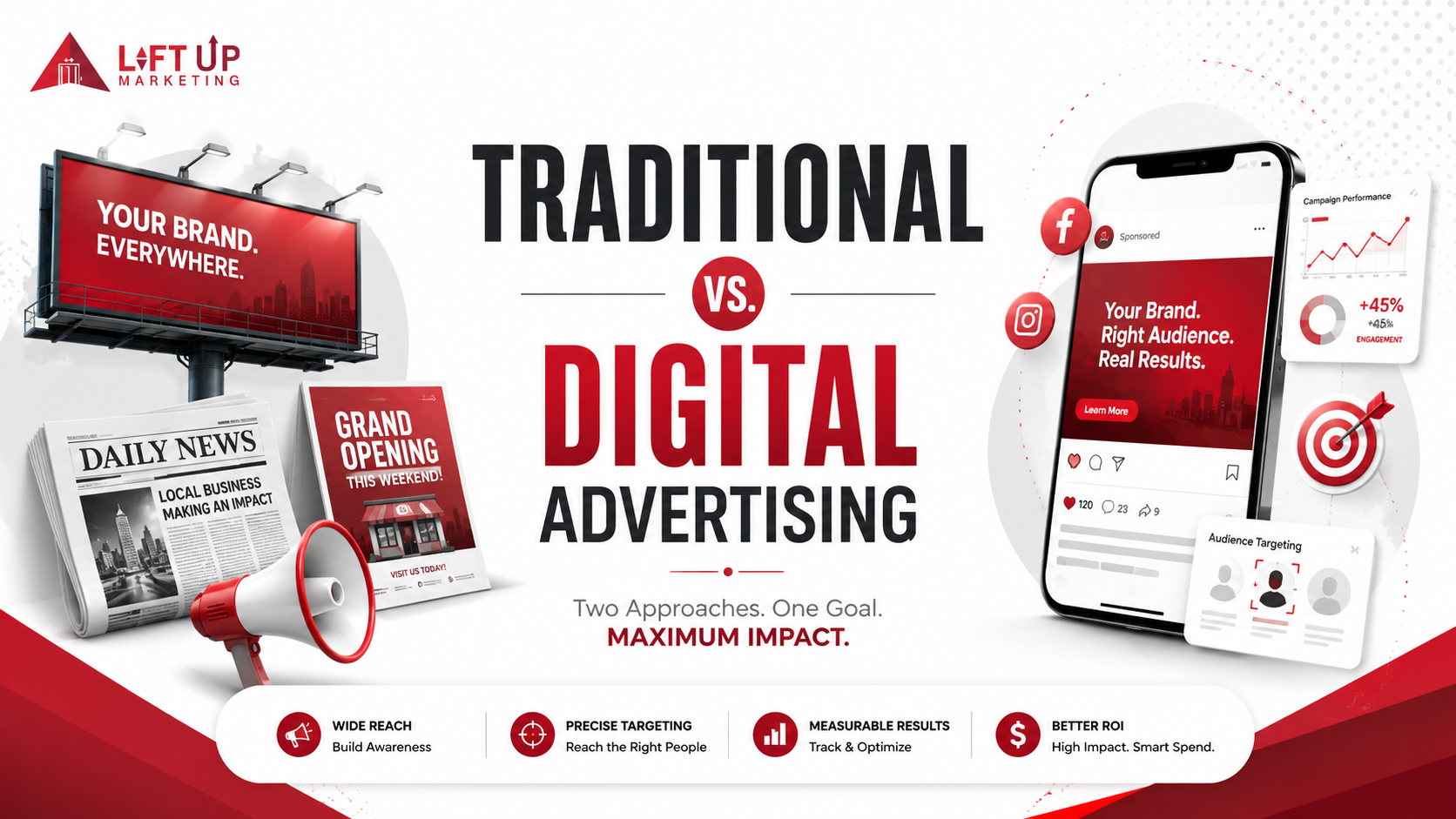
Why Traditional vs. Digital Advertising Is the Wrong Frame
The word “traditional” implies outdated. Elevator advertising isn’t traditional in the same sense as a newspaper classified ad. It’s environmentally contextual advertising — a category that’s actually growing, because it’s one of the few formats that hasn’t been algorithmically saturated.
The irony is sharp: while everyone rushed to digital, offline inventory — especially premium indoor placements — became less competitive, more affordable relative to reach, and psychologically more effective as digital noise increased.
Innovative Offline Marketing Ideas That Actually Work in 2024–25
If you’re rethinking your offline marketing mix, elevator advertising is the headline act — but here’s how sharp local brands are thinking about the broader ecosystem:
1. Society Lift Advertising + Resident WhatsApp Community Activation Run the lift ad as the awareness layer, then geo-target the same society’s WhatsApp community groups (with permission-based methods) for a digital follow-up. Same audience, double-touch.
2. Premium Society Advertising + Event Sponsorship Advertise in a housing society’s elevator for 90 days, and simultaneously sponsor their annual cultural or sports event. The lift ad builds familiarity; the event sponsorship builds trust.
3. Commercial Tower Lift Ads for B2B Outreach If you’re selling HR software, office furniture, corporate wellness solutions, or B2B financial products — a lift ad inside the right commercial tower puts you in front of decision-makers every single workday. No LinkedIn targeting required.
4. Seasonal Campaign Bursts Launch a 30-day intensive elevator campaign during peak business seasons — festive quarter, school admission season, new financial year. Concentrated frequency during high-intent periods.
“The most underrated B2B offline marketing strategy is simply being the brand that decision-makers see repeatedly in their physical environment. Familiarity drives trust. Trust lowers sales friction.”
B2B Offline Marketing Strategies: Why Physical Presence Still Wins
For B2B brands specifically, the offline trust signal is disproportionately powerful. Here’s why:
Enterprise and mid-market purchasing decisions involve multiple stakeholders, longer sales cycles, and higher perceived risk. In that environment, brand familiarity is a risk-reducer. When a procurement head or business owner has seen your brand repeatedly — in the elevator of their own office building, for example — the cold outreach email hits a warm inbox.
This is the “mere exposure effect” at work: psychological research consistently shows that familiarity with a stimulus (your brand name, logo, or tagline) increases positive evaluation of it, even without conscious memory of where the familiarity came from.
For B2B offline marketing, the most effective strategies combine:
- Consistent visual identity across all placements (same logo, colour, and message)
- Problem-led messaging (not just branding — what problem you solve, for whom)
- Clear next steps (a QR code, website, or phone number — always on the creative)
- Sustained duration (minimum 60–90 days to reach effective frequency thresholds)
LiftUp Marketing works with B2B brands to identify which commercial properties in their target city have the highest concentration of relevant decision-makers — and builds campaigns around those specific buildings.
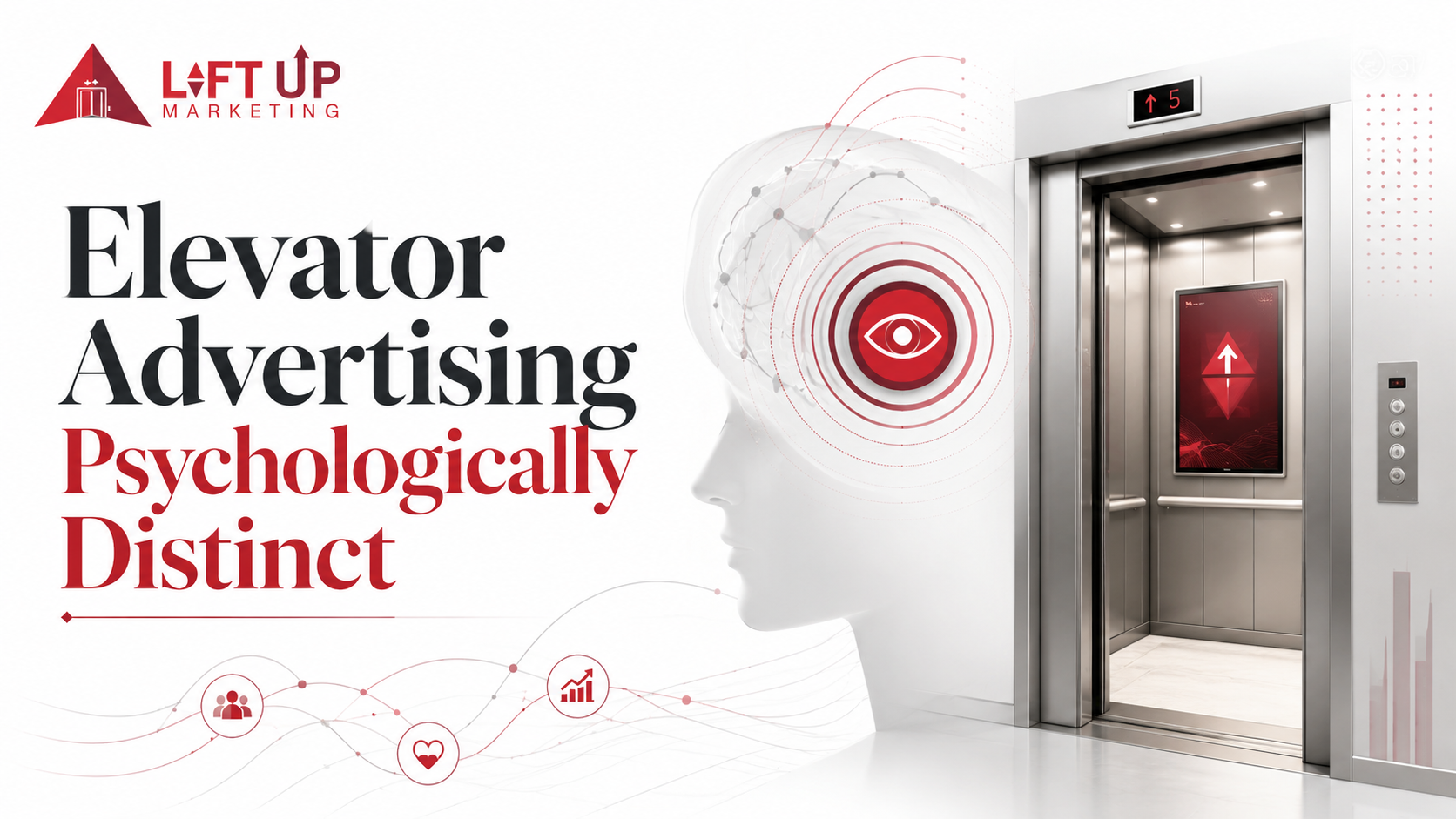
What Makes Elevator Advertising Psychologically Distinct
Let’s get specific about the neuroscience, because it matters for how you brief your creative.
In elevator environments, the brain is in what researchers call a “transitional mindset” — moving between locations, between tasks, between social contexts. This state is actually more receptive to new information than both high-stress active states and deep-focus states. It’s cognitively similar to the few minutes before falling asleep — when ideas tend to stick.
This is why elevator ad creative should:
Lead with curiosity or a problem statement, not a product feature. “Is your child getting the coaching they actually need?” performs better than “Enroll now at ABC Academy.”
Use bold, clean visuals with minimal copy. This isn’t Instagram — there’s no feed competing with you. The space itself is calm. Let your visual breathe.
Include one clear action. A QR code to a landing page, a memorable phone number, or a short URL. Not five things — one.
Match the environment’s status. If you’re advertising in a premium residential tower, your creative should look premium. Mismatch between ad quality and environmental context undermines the psychological benefit of being in a captive, high-status placement.
The LiftUp Marketing Advantage: Why We’re Not Just a Media Vendor
At LiftUp Marketing, we don’t just sell wall space. We do three things that most lift advertising vendors don’t:
1. Audience Curation First Before recommending any placement, we analyse the society — property values, resident demographics, occupancy patterns, and proximity to your customer’s natural purchase journey. Not all buildings are equal. We help you target the right ones.
2. Creative Consultation Most brands that come to us have never done elevator advertising before. We advise on creative formats, messaging hierarchy, and visual approach — because a technically correct ad in the wrong format still underperforms.
3. Campaign Tracking and Renewal Strategy We track campaign placements, gather feedback from ground teams, and help brands build a compounding frequency strategy across multiple properties over successive cycles — so awareness builds, not just accumulates.
Our inventory spans premium residential societies and commercial towers across Punjab, and we work with brands in real estate, education, healthcare, FMCG, financial services, retail, and the B2B space.
Ready to Reach Exactly the Right Audience — Without Fighting the Algorithm?
If you’re a business owner or marketing head who’s tired of paying more for digital and getting less, let’s talk about what a targeted elevator advertising campaign could look like for your brand.
We’ll put together a customised society list — matched to your target audience’s location, income tier, and daily movement patterns — along with a campaign recommendation and budget outline. No fluff, no generic media kits.
Get Your Customised Society List + Free Campaign Consultation →
Contact LiftUp Marketing directly to speak with our team about available placements in your target market.
LiftUp Marketing | Premium Elevator & Lift Advertising | Punjab & Beyond www.liftupmarketing.in