

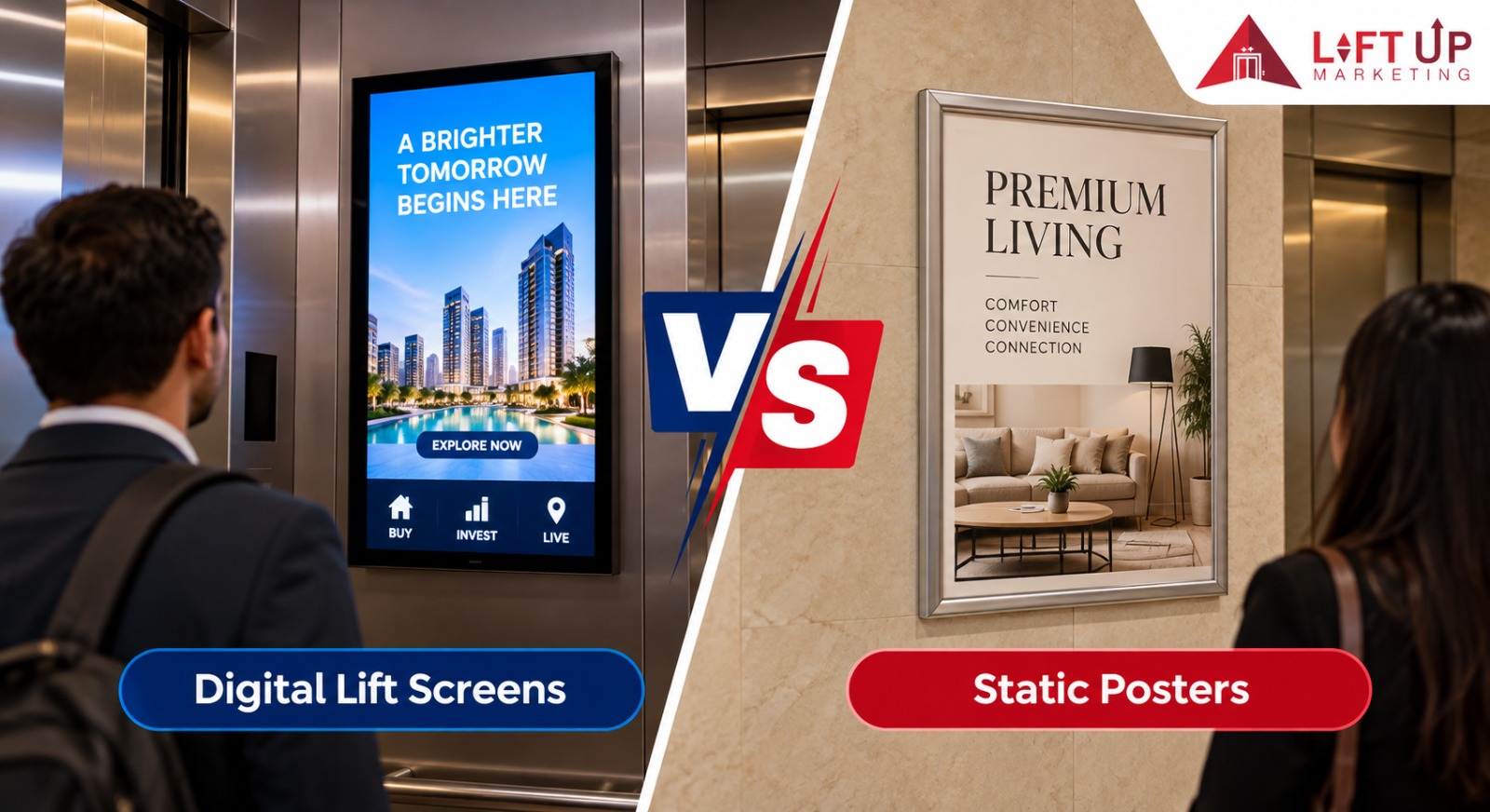
Digital lift screens display changing video or image content and can update instantly, while static posters show one fixed design for the length of a campaign. Research shows digital signage genuinely boosts engagement — a large 2026 field study of 30 million shoppers found digital displays increased product sales by an average of 8%. But static posters still win on cost, reliability, and simplicity — especially inside elevators, where space is small and viewing time is short. The right choice depends less on “which is better” and more on your budget, campaign length, and how often your message needs to change.
What Is a Static Poster?
A static poster is a printed advertisement that shows one fixed design for as long as it’s displayed — no movement, no video, no updates until someone physically replaces it. Inside a lift, this usually means a laminated or printed sheet placed in a poster frame at eye level.
Key features of static posters:
- One fixed image and message for the whole campaign
- No electricity or internet needed
- Changed only by physically swapping the print
- Lower upfront cost, simple to produce and install
What Is Digital Signage?
Digital signage uses an electronic screen — usually LED or LCD — to show content that can include video, animation, or rotating images. Unlike a poster, it can display multiple ads on rotation, update in real time, and even include interactive elements like QR codes or touch response.
Static vs Digital Signage: Side-by-Side Comparison
| Factor | Static Posters | Digital Signage |
|---|---|---|
| Upfront cost | Low | High (screen + installation) |
| Running cost | None (no power needed) | Ongoing — electricity, maintenance |
| Content updates | Requires physical replacement | Instant, remote update |
| Number of ads shown | One per poster | Multiple, on rotation |
| Attention grab | Moderate | Higher — motion draws the eye |
| Reliability | Very high — nothing to break | Depends on power, connectivity |
| Best for | Long campaigns, tight budgets | Frequent content changes, premium locations |
Digital Signage vs Static Posters: What the Research Actually Shows
It’s worth being precise here, since a lot of marketing blogs throw around big, vague percentages for digital signage without a clear source. The most rigorous, recent evidence comes from a 2026 study published in the Journal of Marketing by Herhausen, de Jong, and Grewal — one of the largest field experiments on this exact topic, covering 30 million shoppers across 237 in-store advertising campaigns. It found that digital signage increased sales of advertised products by an average of 8%, with the effect being stronger for low-priced, everyday items.
This is a more conservative — and more trustworthy — number than some of the bigger claims floating around online, precisely because of the scale and rigor of the study behind it. Genuine engagement gains are real, but they’re incremental, not dramatic — worth knowing before you invest in expensive screens expecting an overnight transformation.
Interactive vs Static Displays: Adding a Layer Beyond “Digital”
Not all digital signage is the same. Interactive displays go a step further than simple digital screens — think touch-response panels, QR-code-linked content, or screens that respond to a viewer’s presence. Inside a lift, full touch-interactivity is rarely practical, but a QR code printed on a static poster gives you a low-cost way to add a “digital” layer — tracking, redirection to a website, or a special offer — without the cost of an actual screen.
This middle path is worth considering: a static poster with a scannable code captures some of digital’s trackability while keeping the low cost and reliability of print.
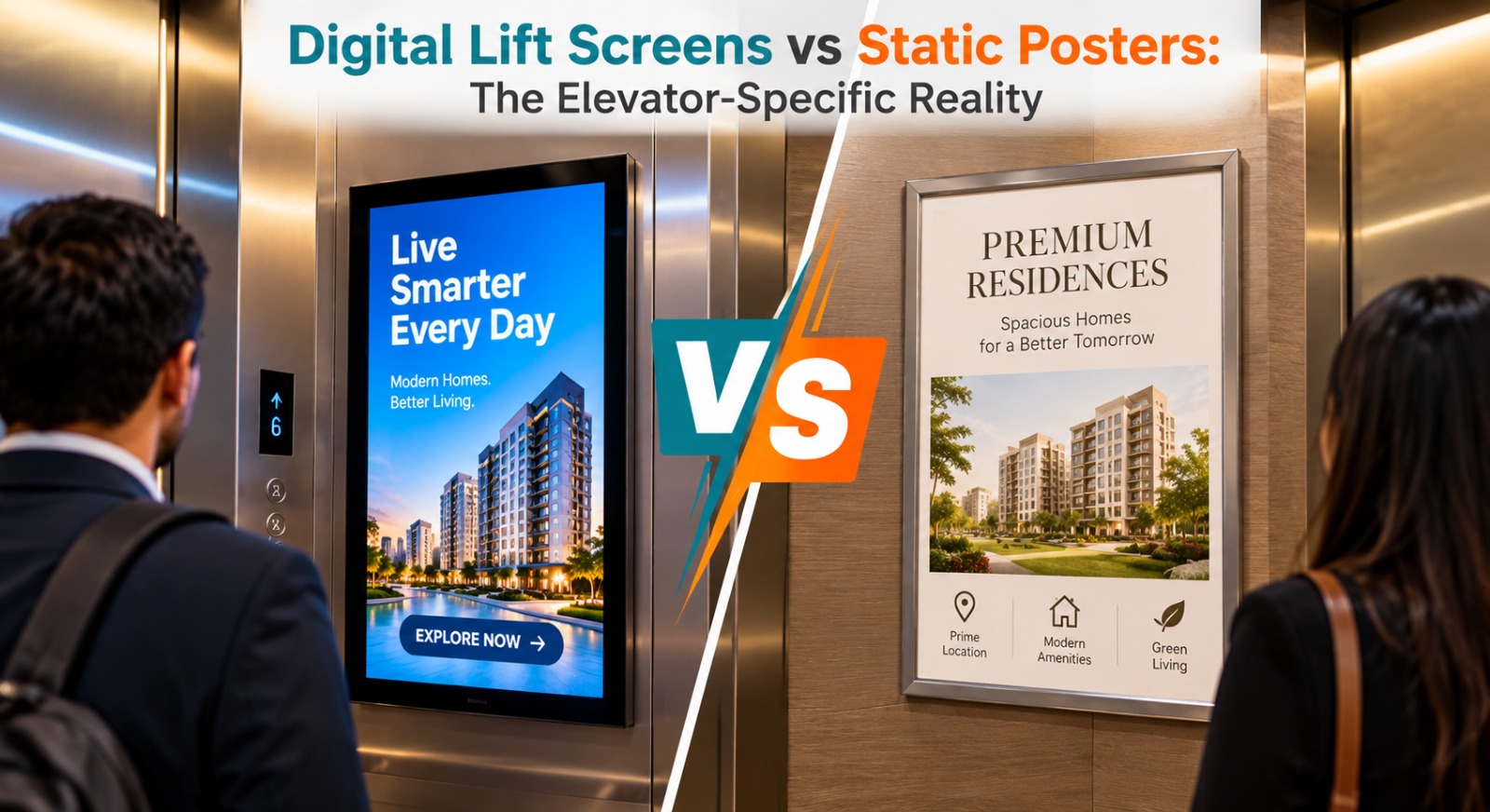
Digital Lift Screens vs Static Posters: The Elevator-Specific Reality
Elevators are a genuinely unique advertising environment, and the usual “digital vs static” debate plays out a little differently here:
Why Static Posters Still Dominate in Lifts
- No power or internet dependency — a lift’s electrical system is already dedicated to running the elevator itself; adding screens means extra wiring and reliability risk
- Short viewing window — most lift rides last 20-60 seconds, often too short for a screen to cycle through multiple ads meaningfully
- Lower cost per building — makes it financially realistic to place ads across many societies at once, rather than concentrating spend on a few screen installations
- Maintenance-free — no bulbs, no software updates, no technician visits needed
Where Digital Lift Screens Can Make Sense
- High-footfall commercial buildings, where the investment can be spread across thousands of daily riders
- Premium residential towers, where a modern, tech-forward look aligns with the building’s positioning
- Campaigns needing frequent content changes — for example, a mall or office complex running different promotions weekly
What Are the Disadvantages of Digital Signage?
Digital signage isn’t universally better — it comes with real trade-offs worth knowing before you commit:
- Higher upfront and running cost — screens, installation, and ongoing electricity all add up compared to a simple printed poster
- Technical dependency — a screen can freeze, lose connectivity, or simply break, while a poster never “goes offline”
- Ambient light issues — bright daylight or reflective surfaces can wash out screen visibility, an issue static print doesn’t face
- Content creation cost — video or animated content typically costs more to produce than a single static design
- Shorter effective lifespan — screens are electronic hardware that ages, unlike a laminated poster that simply gets replaced when the campaign ends
What Are the Different Types of Digital Posters?
“Digital poster” covers a range of formats, each suited to different environments:
- Single-screen digital posters — one screen showing rotating static images or slides, the closest digital equivalent to a printed poster
- Video wall displays — multiple screens joined together for large-format impact, typically used in malls or large lobbies
- Interactive touchscreens — allow viewer interaction, common in retail and information kiosks
- Networked digital signage — multiple screens across different locations, all managed and updated from one central system
For elevator advertising specifically, a single-screen digital poster is the most realistic format — video walls and multi-screen networks are rarely practical in the confined space of a lift.
What Are the Differences Between a Poster and a Digital Poster?
At the core, the difference comes down to movement and updatability:
| Poster (Static) | Digital Poster | |
|---|---|---|
| Content | Fixed, single design | Can rotate, animate, or update remotely |
| Update process | Physical replacement | Instant, from a connected device |
| Cost to change content | New print each time | Free or low-cost after initial setup |
| Power required | None | Yes |
| Typical lifespan | Until physically damaged or removed | Hardware lifespan (several years), content is unlimited |
How to Decide Between Digital and Static for Your Campaign
- How long will your campaign run? Longer campaigns can better justify a screen’s higher upfront cost.
- How many locations do you need to cover? Static posters let your budget stretch across more buildings at once.
- How often does your message need to change? If you’re running the same offer for months, static wins on cost. If you need weekly updates, digital saves on reprinting.
- What’s the viewing environment? A short elevator ride favours a single, clear static message over content that needs time to cycle through.
Final Thoughts
Neither format is a universal winner — the real 2026 research shows digital signage delivers a genuine but modest engagement boost, while static posters remain the more practical, reliable, and cost-effective choice for most elevator advertising campaigns. The smartest approach is often a hybrid: static posters for broad, budget-friendly coverage across many buildings, with digital or QR-enhanced options reserved for a smaller number of premium, high-footfall locations.
FAQs
Q1. What are the differences between a poster and a digital poster?
A poster is a fixed, printed design that stays the same until physically replaced. A digital poster uses a screen, allowing content to rotate, animate, or be updated instantly without reprinting.
Q2. What is a static poster?
A static poster is a printed advertisement showing one fixed design for the length of a campaign, with no movement, video, or remote update capability—common in elevators, notice boards, and shopfronts.
Q3. What are the disadvantages of digital signage?
Higher upfront and running costs, dependency on power and connectivity, visibility issues in bright light, more expensive content production, and the risk of technical failure are the main drawbacks compared to static signage.
Q4. What are the different types of digital posters?
Common types include single-screen digital posters, video wall displays, interactive touchscreens, and networked digital signage systems managed across multiple locations from one platform.
Q5. Is digital signage worth it for elevator advertising specifically?
It can be, in high-footfall commercial or premium residential buildings where cost can be justified across many daily viewers — but for most elevator campaigns across multiple societies, static posters remain more cost-effective and reliable.
Q6. Do digital signs actually increase sales more than static ones?
Yes, based on rigorous 2026 research, but the effect is modest — an average 8% sales increase for advertised products, not the dramatic jumps sometimes claimed in less rigorous marketing statistics.
Sources
Related Reading
Want Advertising That Fits Your Budget and Your Building?
Whether static posters or a digital-enhanced approach fits your campaign better, LiftUp helps you choose the right format for your target audience and budget. Get in touch to plan your next elevator advertising campaign.