
A lift advertising screen is a digital display — usually 10 to 22 inches — installed inside an elevator cab or lobby to show rotating ads, brand content, and building information. Advertising on an existing screen (buying ad space as a brand) typically costs far less than buying and installing the hardware yourself, and pricing depends on the building, screen count, and campaign length. If you’re looking at hardware costs instead — buying and installing your own screen — commercial elevator display units in India range from roughly ₹10,500 to ₹20,000+ per unit, before installation and content management software.
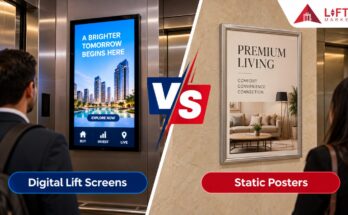
Lift Advertising Screen vs. Elevator Advertising Poster: What’s the Difference?
Before diving into cost, it helps to know exactly what you’re comparing:
| Feature | Lift Advertising Screen (Digital) | Elevator Advertising Poster (Static) |
|---|---|---|
| Format | Digital display, rotating content | Printed, fixed image |
| Content changes | Instantly, remotely | Requires physical replacement |
| Multiple advertisers | Yes, rotating slots | One ad per space |
| Setup cost | Higher (hardware + installation) | Lower (print + placement) |
| Best for | Buildings/agencies running long-term, multi-brand campaigns | Single-brand campaigns, shorter runs |
Both formats work on the same core idea — a captive, undistracted audience during a short elevator ride — but a screen adds flexibility that a printed poster simply can’t match.
What Is a Lift Advertising Screen, Exactly?
A lift advertising screen (also called an elevator advertising display) is a commercial-grade LCD or LED panel installed inside an elevator cab, above the door, or in the lobby waiting area. It typically runs on a Content Management System (CMS), letting an operator update ads remotely — across one building or hundreds — without ever touching the physical screen.
Common screen sizes:
- In-cab screens: 10 to 22 inches
- Lobby or elevator bank screens: 32 to 55 inches, placed where people wait, not just where they ride
How Much Does It Cost to Advertise on Lifts?
This is the question most brands actually want answered — and it’s different from the cost of buying a screen.
As an advertiser, you’re typically paying for ad space and airtime, not the hardware itself. Pricing depends on:
- Number of buildings/screens your ad appears on
- Campaign duration (a 2-week run costs less than a 3-month run)
- Rotation frequency — how often your ad appears within the loop
- Building type and location — premium residential towers or commercial hubs typically cost more than smaller societies
Since this varies so much by building and city, the most reliable way to get an accurate number is a direct quote based on your specific target locations — a generic “average price” would honestly be more misleading than helpful here.
How Much Does a Lift Advertising Screen Cost? (Hardware Pricing)
If you’re a building owner, developer, or agency looking to install your own screens rather than advertise on existing ones, here’s what the hardware side typically costs in the Indian market:
| Component | Typical Price Range |
|---|---|
| Basic 10.4″ TFT LCD display unit | ₹10,500 – ₹15,000 |
| Larger LCD/LED elevator display | ₹15,000 – ₹20,000+ |
| Installation (wiring, mounting, power routing) | Varies by building, often quoted separately |
| CMS software/subscription | Often billed monthly or annually, separate from hardware |
| AMC (Annual Maintenance Contract) | Commonly offered by suppliers as an add-on |
Elevator advertising screen price can climb higher for larger lobby-bank displays (32-55 inches) or units with extra features like touch capability, built-in cameras, or dual screens for two-sided ad content.
Impact of Lift Advertising Screens: What the Data Shows
Elevator advertising’s core advantage is the captive, undistracted audience — but how does that actually translate to results? According to industry reporting from AdQuick, a US-based place-based advertising platform:
- Elevator ads have shown recall rates up to 4.2 times higher than standard digital display ads
- Around 70% of riders recall brands advertised in elevators
- Campaigns in premium office buildings have shown a 17% lift in purchase intent over four-week campaign flights
Note: these figures come from AdQuick’s reported industry research, based primarily on US commercial buildings — Indian residential and commercial elevator environments may show different specific numbers, but the underlying principle (captive audience = stronger recall) applies broadly across markets.
Why Digital Screens Are the Fastest-Growing Elevator Ad Format
Digital elevator screens are increasingly replacing static posters for a simple reason: flexibility. A single screen can rotate:
- Multiple advertisers’ content across a single ad loop
- Time-sensitive offers (updated instantly, no reprinting)
- Building announcements alongside paid ads
- Different content for morning vs. evening rush, if the CMS supports scheduling
This flexibility is part of a much bigger shift happening across Indian advertising — the growth of DOOH (Digital Out-of-Home) media, where screens in malls, metro stations, and buildings are replacing static hoardings across the country.
What Is “Lift” in Marketing? (A Common Mix-Up, Clarified)
Here’s something worth clarifying honestly: if you searched “what is lift in marketing” hoping to learn about elevator ads, there’s actually a second, unrelated meaning of the word “lift” in the marketing world.
“Lift” as a marketing metric refers to the measurable increase in a business outcome — sales, brand awareness, purchase intent — caused by a specific campaign. For example, “the campaign produced a 15% lift in sales” simply means sales rose by 15% compared to before the campaign ran.
“Lift advertising” (what this article is about) refers specifically to advertising placed inside elevators (lifts).
Interestingly, the two do connect in one real way: a well-run lift advertising campaign can genuinely help produce brand lift — using the technical marketing sense of the word — because of the strong recall elevator ads are known for.
What Is an Advertising Screen Called?
An advertising screen — whether in an elevator, mall, or metro station — falls under the broader industry term “digital signage”, and more specifically, this entire category of screens placed in public or semi-public spaces is called DOOH (Digital Out-of-Home) advertising. “Elevator advertising screen” and “lift advertising display” are simply the specific, location-based names for this format.
Which Option Makes More Sense: Advertise on Existing Screens, or Install Your Own?
Advertise on existing screens if:
- You’re a brand or business wanting quick, flexible campaign placement
- You want to reach residents/employees across many buildings without owning hardware
- You want to test the format before any bigger commitment
Install your own screens if:
- You own or manage a building and want to monetize ad space yourself
- You want full control over content, scheduling, and which advertisers appear
- You’re building a long-term, multi-tenant ad network across several properties
Common Mistakes to Avoid
- Assuming screen cost and ad-space cost are the same thing — they’re two entirely different pricing models
- Choosing screen size without considering the viewing distance — a small in-cab screen and a large lobby screen serve different purposes
- Ignoring CMS and maintenance costs — the hardware price is rarely the full picture
- Running the same static content for too long — even on a digital screen, stale content reduces the recall advantage this format is known for
FAQs
Q1. How much does a lift advertising screen cost?
Commercial elevator display hardware in India typically ranges from ₹10,500 to ₹20,000+ per unit, depending on screen size, before installation and CMS software costs are added.
Q2. How much does it cost to advertise on lifts?
Advertising cost depends on the number of buildings, campaign duration, and rotation frequency, rather than a fixed hardware price. It’s best assessed with a direct quote based on your target locations and campaign goals.
Q3. What is lift in marketing?
“Lift” in general marketing refers to a measurable increase in an outcome, like sales or brand awareness, caused by a campaign. “Lift advertising” is a separate term referring specifically to ads placed inside elevators.
Q4. What is an advertising screen called?
An advertising screen falls under the term “digital signage,” and screens placed in public or semi-public locations like elevators, malls, or transit stations are broadly categorised as DOOH (Digital Out-of-Home) advertising.
Q5. Are digital lift advertising screens better than printed posters?
Digital screens offer more flexibility — instant content updates, multiple rotating advertisers, and scheduling by time of day — while printed posters are simpler and cheaper for short, single-brand campaigns.
Q6. Do all elevators support digital advertising screens?
Most modern elevator cabs can support a retrofitted display with proper installation, though older elevators may need additional wiring or power routing work before a screen can be added.
Sources
- AdQuick — Elevator Advertising: Costs, Formats & How to Buy
- IndiaMart — Elevator LCD Display Market Listings, 2026
Related Reading
- How to Choose the Right Lift Advertising Company in India
- The ROI of Lift Advertising: What Brands in India Can Expect
Want to Advertise on Lift Screens Without Buying Hardware?
LiftUp gives brands access to elevator advertising space across residential and commercial buildings — no hardware purchase, no installation hassle. See how it works or get in touch for a campaign quote based on your target locations.