
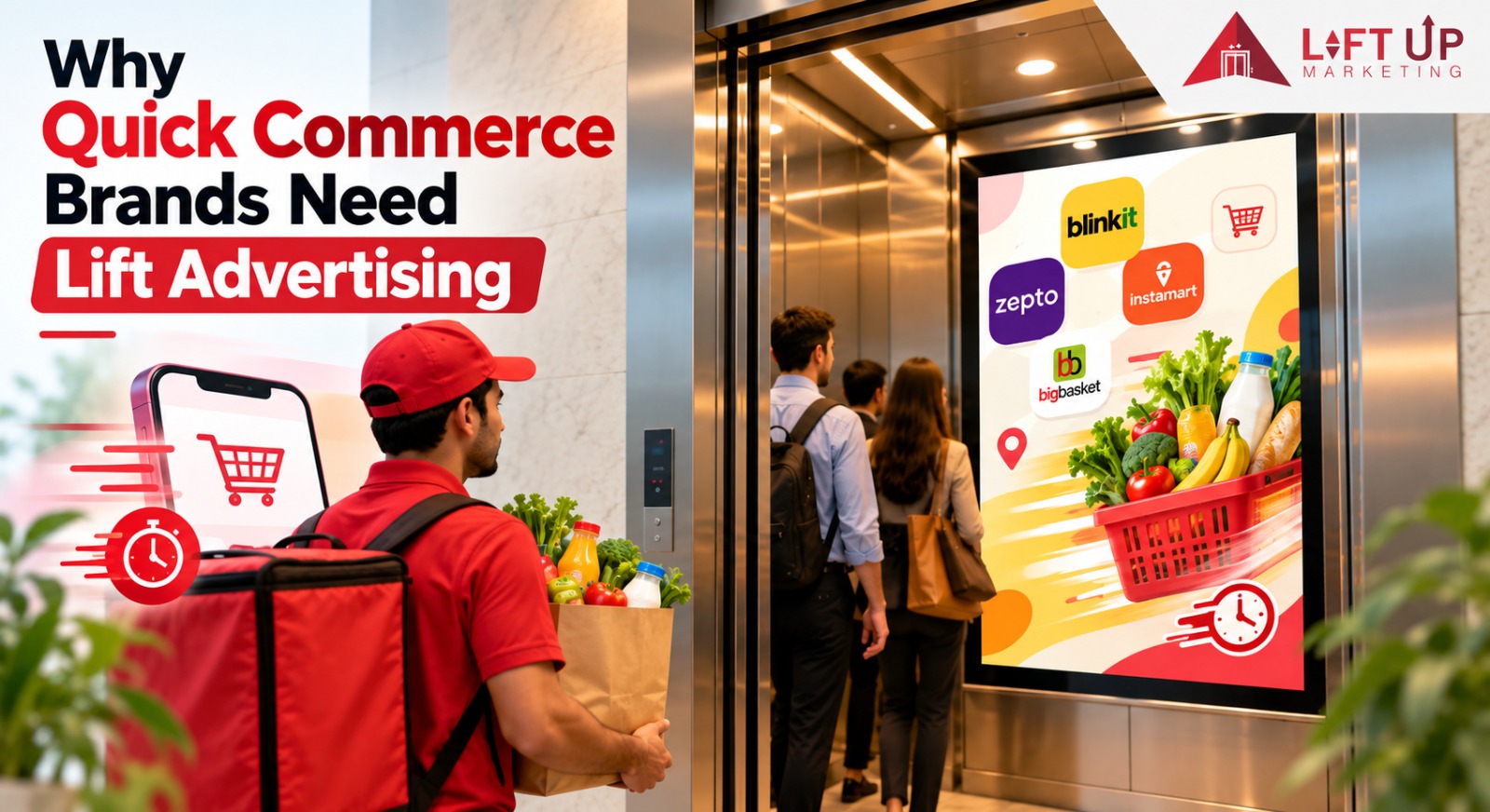
Quick commerce brands need lift advertising because their entire business model depends on customers within a 2-3 km radius of a dark store — and elevator advertising is the only medium that puts your brand directly inside that exact radius, inside the very buildings where your target customers live. With over 6,000 dark stores now operating across India and delivery apps fighting for the same nearby customers, generic city-wide ads waste budget on people too far away to ever order. Lift advertising fixes this by targeting the specific residential societies within your delivery zone — nowhere else, nothing wasted.
The Quick Commerce Boom: Why This Matters Right Now
India’s quick commerce sector has moved from a niche experiment to a genuine retail force. A few numbers show just how fast:
- India crossed 6,000 operational dark stores in 2026, with thousands more opening through the year (BharatBusinessIndex, June 2026)
- Blinkit alone operates 2,200+ dark stores, while Swiggy Instamart has crossed 1,100+ locations across 100+ cities (company disclosures, 2026)
- Estimates on total market size vary by research methodology — from roughly $3.65 billion to over $11 billion depending on what’s measured (GMV vs. revenue), but every major report agrees on one thing: growth rates above 20-70% year-on-year, among the fastest in Indian retail
This scale matters because it changes where the competition actually happens. Quick commerce isn’t fighting for attention across an entire city — it’s fighting building by building, society by society, within a tiny delivery radius.
Why Dark Stores Change the Advertising Game Completely
A dark store isn’t a shop people walk into — it’s a mini-warehouse that only exists to serve orders within a short delivery radius, typically 2-3 kilometres. This single fact should completely reshape how a quick commerce brand thinks about advertising:
Traditional advertising problem: A hoarding, a radio ad, or a city-wide digital campaign reaches people all over the city — most of whom live nowhere near your nearest dark store and can never actually order from you.
The lift advertising fix: Elevator ads let you place your brand inside the exact residential societies within your delivery zone — nowhere further, nothing wasted.
Lift Advertising for Quick Commerce Brands: How It Actually Works
| Step | What Happens |
|---|---|
| 1. Map your dark store’s delivery radius | Identify the 2-3 km zone your store actually serves |
| 2. Select societies within that radius | Choose residential buildings genuinely inside your service area |
| 3. Place your ad inside the lift | Reach residents daily, during a captive, distraction-free ride |
| 4. Track response | Use a promo code specific to the campaign to measure actual orders |
This is fundamentally different from most advertising, which reaches people first and hopes some happen to be nearby. Lift advertising starts with “nearby” as the selection criteria.
Elevator Advertising for Dark Stores: The Direct Connection
Think about what a dark store actually needs to succeed: repeat orders from a small, fixed set of nearby households. That’s it. It doesn’t need brand awareness across an entire city — a dark store in one part of town can’t fulfil an order from the other side anyway.
Elevator advertising matches this need precisely:
- Repeated exposure — residents see your ad daily, building the habit of “when I need something fast, I think of this app”
- Zero wasted reach — every viewer is a potential customer, since they live within your actual delivery zone
- Trust through familiarity — an ad inside your own building feels more credible than a random app notification from an unfamiliar brand
Housing Society Advertising for Delivery Apps: Why It Beats Generic App-Store Ads
Delivery apps spend enormous budgets competing for app installs through Google and social media ads — but an install means nothing if the person lives outside your delivery zone. Housing society advertising for delivery apps flips this completely: instead of getting a download from anywhere, you get visibility specifically among people who can actually place an order tomorrow morning.
This is particularly powerful for:
- New dark store launches — build immediate local awareness the moment a store goes live
- Category expansion — telling existing local customers about a new product line (medicines, beauty, electronics) now available for fast delivery
- Competing against a rival platform already active in the same societies
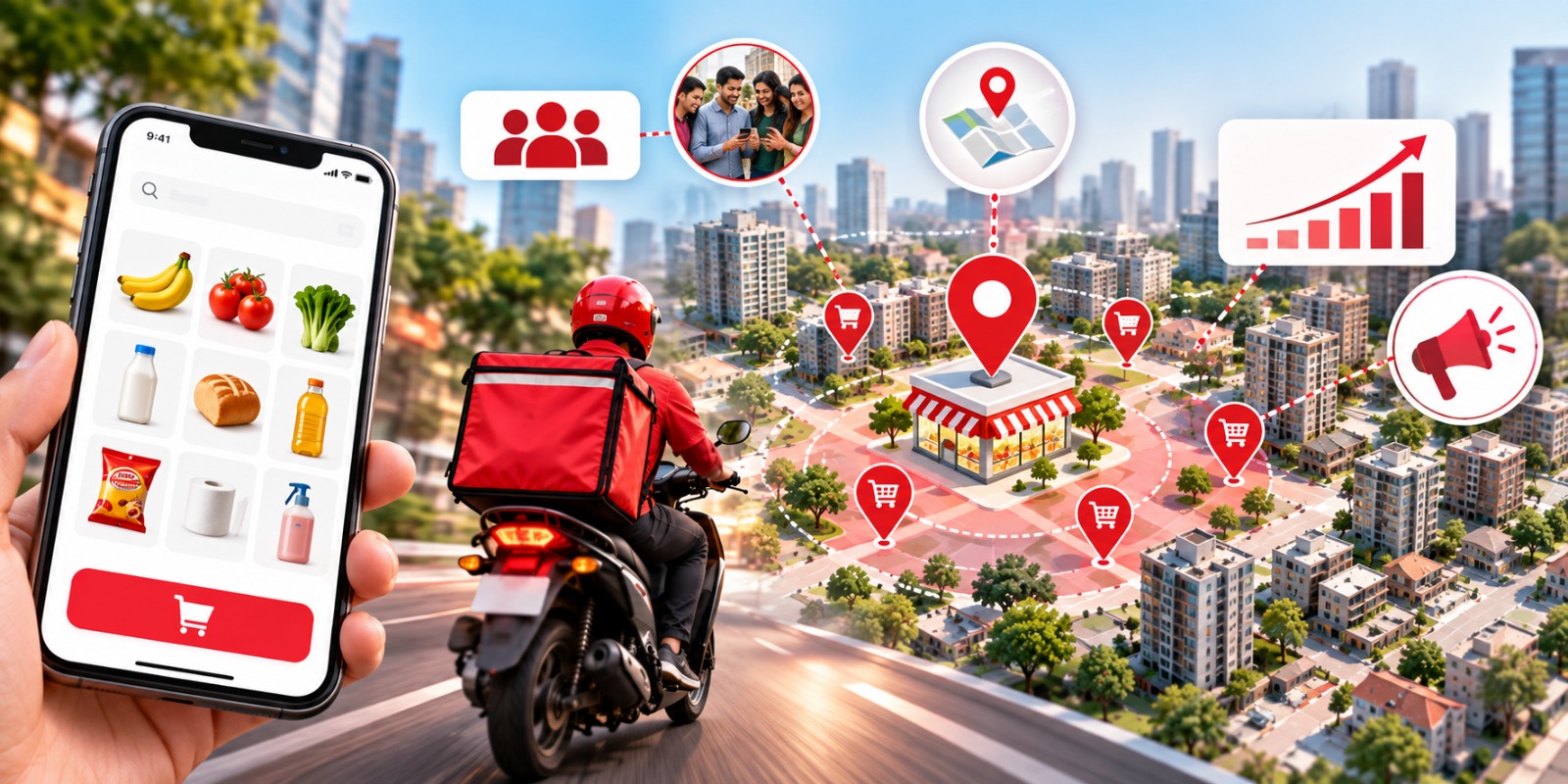
Hyperlocal Marketing for Quick Commerce: The Bigger Strategic Shift
“Hyperlocal marketing” has become one of the most important ideas in Indian retail — and quick commerce is arguably the industry that needs it most. Unlike a traditional e-commerce brand shipping nationwide, a quick commerce brand’s entire value proposition — 10-minute delivery — is only as good as its density in a specific neighbourhood.
Why hyperlocal marketing for quick commerce specifically makes sense:
- Your customer base is defined by geography first, demographics second
- Local trust and word-of-mouth spread faster within a single society than across a city
- Budget efficiency is dramatically higher when every rupee reaches only people who can convert
Lift advertising is, in many ways, the most literal form of hyperlocal marketing available — you’re not just targeting a pin code, you’re targeting the exact building.
The 3-3-3 Rule in Marketing: A Simple Framework Quick Commerce Brands Can Borrow
There’s no single official definition of the “3-3-3 rule” — different marketers use it slightly differently — but the most common version focuses on: three key messages, delivered through three channels, reinforced across three touchpoints, to keep communication simple and memorable rather than overloaded.
For a quick commerce brand using lift advertising, this could look like:
- Three messages: speed (“delivered in 10 minutes”), convenience (“groceries without leaving home”), a specific offer (first-order discount)
- Three channels: elevator ads in target societies, app push notifications, social media retargeting
- Three touchpoints: the lift poster itself, a QR code leading to the app, and a follow-up notification once installed
Keeping the message this simple matters even more in an elevator, where viewers have only a 20-60 second window — there’s no room for a cluttered, seven-point pitch.
Disadvantages of Quick Commerce (And Why Local Ads Help Offset Them)
Quick commerce isn’t without real challenges, and it’s worth being upfront about them:
- Thin unit economics — delivery and operational costs are high relative to average order value, making profitability difficult for many players
- Heavy discount dependency — customer loyalty is often tied to promotions rather than genuine brand preference
- Limited reach in non-metro areas — the model works best in dense urban pockets, with weaker penetration elsewhere
- Pressure on local kirana stores — a debated but real concern in India’s retail ecosystem
- Delivery partner working conditions — an ongoing area of public and regulatory scrutiny
Here’s the connection to advertising: because margins are thin, wasted ad spend is especially costly for quick commerce brands. A hyperlocal channel like lift advertising, which avoids reaching people outside the deliverable radius, directly addresses the unit-economics problem by reducing customer acquisition cost per relevant impression.
What Are the Most Sold Products on Quick Commerce?
Quick commerce started with groceries but has expanded well beyond that:
- Groceries and fresh produce — the original and still largest category
- FMCG staples — packaged food, personal care, household essentials
- Medicines and health products — a fast-growing category as platforms add pharmacy delivery
- Beauty and personal care — an emerging, higher-margin category some platforms are pushing into
- Snacks and instant food — high-frequency, impulse-driven purchases
This expanding product range matters for advertising strategy — a brand can now run different campaigns for different categories within the same residential societies, based on what’s actually being sold there.
What Are the 7 Main Types of Advertising?
For context on where lift advertising fits within the broader advertising landscape:
- Print Advertising — newspapers, magazines, brochures
- Broadcast Advertising — television and radio
- Outdoor/OOH Advertising — hoardings, billboards, transit ads
- Digital Advertising — search, display, and programmatic ads online
- Social Media Advertising — sponsored posts and influencer content
- Direct Marketing — email, SMS, and direct mail
- Experiential/Hyperlocal Advertising — in-person, location-specific formats, including elevator and society-level advertising
Lift advertising sits within this last category — and it’s precisely the category best suited to quick commerce’s hyperlocal business model.
Getting Started: A Practical Checklist for Quick Commerce Brands
- Map the exact delivery radius of each dark store you’re promoting
- Identify residential societies genuinely within that radius
- Keep your ad message simple — one clear benefit, one clear call to action
- Include a trackable promo code to measure actual order impact
- Run the campaign long enough to build repeated recognition, not just a single week
FAQs
Q1. Why do quick commerce brands specifically need lift advertising?
Because their business model depends entirely on customers within a 2-3 km dark store radius, and lift advertising is one of the only channels that can target that exact geography — building by building — rather than an entire city.
Q2. What is the 3-3-3 rule in marketing?
It’s a flexible framework, not one official standard, generally meaning three key messages delivered through three channels and reinforced across three touchpoints, to keep marketing communication simple and memorable.
Q3. What are the disadvantages of quick commerce?
Key challenges include thin profit margins, heavy reliance on discounts, weaker reach outside dense urban areas, pressure on local kirana stores, and ongoing scrutiny of delivery worker conditions.
Q4. What are the 7 main types of advertising?
Print, broadcast (TV/radio), outdoor/OOH, digital, social media, direct marketing, and experiential/hyperlocal advertising — the last category includes formats like lift and society-level advertising.
Q5. What are the most sold products on quick commerce platforms?
Groceries and fresh produce remain the largest category, followed by FMCG staples, medicines, personal care and beauty products, and snacks or instant food items.
Q6. How is lift advertising different from a delivery app’s regular digital ads?
Digital app-install ads reach people regardless of location, often outside the actual delivery zone. Lift advertising specifically targets residents inside the buildings within a dark store’s real service radius, reducing wasted spend.
Sources
- BharatBusinessIndex — Quick Commerce India 2026: The Dark Store War Explained (June 2026)
- ResearchAndMarkets / GlobeNewswire — India Quick Commerce Report 2026 (April 2026)
- Mordor Intelligence — Q-Commerce Industry in India Report (2026)
Related Reading
- How to Choose the Right Lift Advertising Company in India
- The ROI of Lift Advertising: What Brands in India Can Expect
Ready to Reach Customers Inside Your Delivery Radius?
LiftUp helps quick commerce and delivery brands run hyperlocal elevator advertising campaigns matched precisely to dark store delivery zones — no wasted reach, just the residents who can actually order. See how it works or get in touch to plan your campaign.