
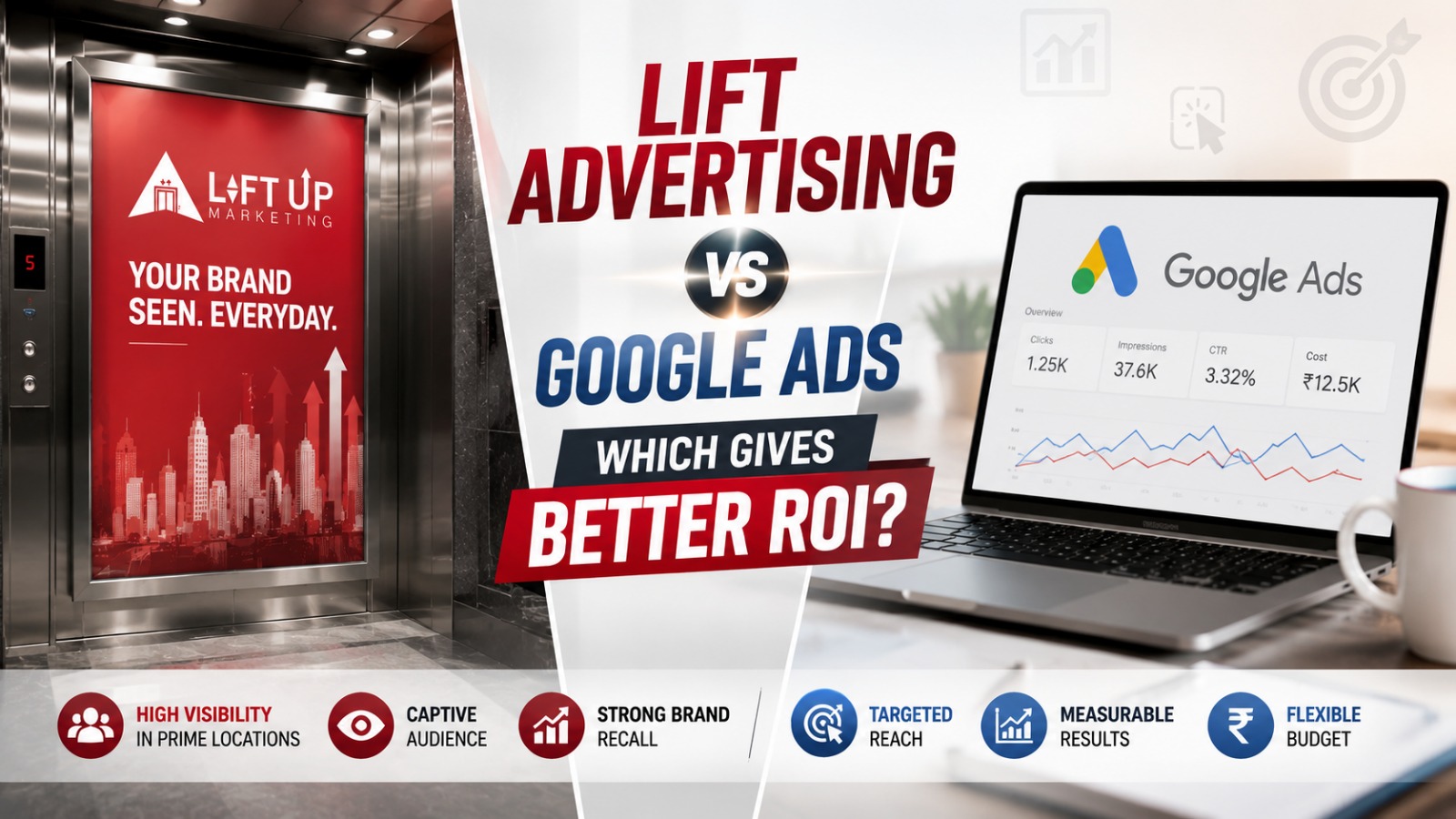
Lift advertising and Google Ads serve different purposes and work best together rather than as a straight replacement for each other. Google Ads offers instant reach and precise intent-based targeting but comes with rising click costs and ad fatigue. Lift advertising offers a captive, distraction-free audience inside residential societies at a fixed, predictable monthly cost, with strong recall for hyperlocal businesses. The right channel depends on your business type, budget, and whether you’re chasing immediate clicks or sustained local visibility.
Introduction
Every marketer eventually asks the same question: where should the next rupee of the advertising budget go? Google Ads has been the default answer for years — instant, measurable, everywhere. But as click costs climb and ad fatigue sets in, more local and hyperlocal businesses are asking whether offline advertising vs digital advertising is really the binary choice it’s made out to be.
This is where lift advertising vs Google Ads becomes a genuinely useful comparison — not because one replaces the other, but because understanding how each actually performs helps you spend smarter, not just spend more.
What Is Lift Advertising?
Lift advertising (also called elevator advertising) is a form of offline, hyperlocal advertising where branded posters or digital screens are placed inside residential or commercial elevators. It captures attention during the 20 to 60 seconds a person spends inside a lift — a rare stretch of undistracted, captive attention in a resident’s day.
Unlike most outdoor advertising, lift ads reach people at a moment when they’re not scrolling, skipping, or multitasking. That’s the core mechanical advantage this format has over most digital formats.
What Is Google Ads?
Google Ads is a pay-per-click (PPC) digital advertising platform where businesses bid on keywords to display ads on Google Search, YouTube, and partner websites. Advertisers pay per click or impression, and campaigns can be launched, adjusted, or paused instantly.
Its biggest strength is intent — someone searching “plumber near me” is often ready to act right now. Its biggest challenge, increasingly, is cost and competition, especially in dense urban markets like Delhi NCR.
Lift Advertising vs Google Ads: Side-by-Side Comparison
| Factor | Lift Advertising | Google Ads |
|---|---|---|
| Cost structure | Fixed monthly cost per site | Pay-per-click, cost varies by keyword competition |
| Typical entry cost (India) | Predictable, budget-friendly for hyperlocal reach | ₹5–₹150+ per click depending on industry |
| Audience attention | Captive, distraction-free (20–60 seconds) | Often skipped, scrolled past, or ignored |
| Targeting method | Geographic — specific societies, buildings, localities | Keyword and intent-based, broader reach |
| Ad fatigue / blindness | Low — limited competing ads in the space | High — banner blindness is well documented |
| Speed to launch | Requires printing/installation lead time | Instant — live within hours |
| Best suited for | Hyperlocal businesses: gyms, clinics, real estate, coaching, retail | Businesses needing broad or national reach, immediate lead generation |
| Trackability | Promo codes, dedicated numbers, QR codes | Native click, conversion, and ROAS tracking |
According to 2026 India PPC benchmarks, average Google Ads CPC ranges roughly from ₹5 for low-competition local keywords up to ₹150 or more in competitive categories like real estate and finance, with legal and finance sectors often paying significantly higher still. That cost applies per click, not per lead — meaning actual customer acquisition cost is often several times higher once conversion rates are factored in.
Cost & ROI: A Practical Breakdown
The comparison people actually care about is lift ads ROI vs Google Ads ROI, not just raw cost. Here’s how to think about it:
Google Ads ROI depends heavily on:
- Your industry’s CPC (which can range from single digits to over ₹150 per click)
- Your landing page and Quality Score, which directly affects what you pay
- Your conversion rate once someone clicks
- Budget scaling — Google Ads generally needs a minimum spend to gather enough data to optimize effectively
Lift Advertising ROI depends on:
- A fixed monthly cost per site, which doesn’t fluctuate with competition or auction dynamics
- The number of societies/buildings your ad runs in, and their audience-brand fit
- How well your creative uses the space’s 20–60 second attention window
- Tracking via promo codes or dedicated contact numbers, which lets you calculate real conversions against a fixed spend
The practical difference: with Google Ads, your cost per lead can quietly rise as competition increases, even if your campaign itself doesn’t change. With lift advertising, your monthly cost is fixed regardless of how many people see or respond to it — which makes budgeting and ROI forecasting considerably more predictable for a fixed-catchment business.
When Google Ads Makes More Sense
- You need leads immediately and can afford to pay for intent-driven clicks
- Your business serves a wide geography, not a specific set of residential clusters
- You have the budget and patience to optimize campaigns over weeks, since Google Ads typically needs volume to improve performance
- Your product or service has a high enough margin to absorb rising CPCs in a competitive category
When Lift Advertising Makes More Sense
- Your customers live in specific residential societies you can identify and target directly
- You’re a hyperlocal business — a gym, clinic, coaching centre, salon, or real estate project — where proximity drives conversion
- You want predictable, fixed monthly costs rather than variable, auction-driven spend
- You’re competing against digital ad fatigue and want a format with genuinely less visual competition
Common Mistakes When Comparing the Two
- Treating it as either/or — Most successful hyperlocal campaigns combine both: Google Ads for intent-driven demand, lift ads for sustained local brand recall.
- Judging lift ads by digital metrics alone — Lift advertising isn’t built for instant click-through tracking the way Google Ads is; it should be measured through promo codes, dedicated numbers, and lead attribution instead.
- Ignoring rising CPC trends — Businesses that set a Google Ads budget once and don’t revisit it often don’t notice their cost per lead climbing over time as competition in their category increases.
- Underestimating ad fatigue — A high CTR today doesn’t guarantee the same performance in six months as audiences become desensitized to repeated ad formats.
A Practical Example
Consider a coaching institute in Indirapuram trying to fill seats for an upcoming batch. Running Google Ads for “coaching classes near me” puts them in competition with dozens of other institutes bidding on the same keywords, often driving up cost per click during admission season specifically. A lift advertising campaign placed across nearby residential societies reaches the exact same target audience — parents and students in the immediate catchment area — at a fixed monthly cost, without bidding against competitors for visibility.
This isn’t a case against Google Ads — it’s a reminder that the “best” channel depends entirely on how tightly defined your target audience’s geography is.
Frequently Asked Questions
Q1. Is lift advertising cheaper than Google Ads?
It depends on your industry and goals. Lift advertising uses a fixed monthly cost model, which is often more predictable than Google Ads, where cost per click can range from a few rupees to over ₹150 depending on competition. For hyperlocal businesses, lift advertising frequently delivers a lower cost per lead.
Q2. Can lift advertising and Google Ads be used together?
Yes, and many businesses see the best results doing exactly this. Google Ads captures active search intent, while lift advertising builds sustained local brand recall in specific residential catchments — together, they reinforce each other rather than compete for the same budget.
Q3. How is ROI measured in lift advertising compared to Google Ads?
Google Ads has built-in click, conversion, and ROAS tracking. Lift advertising ROI is typically measured through promo codes, dedicated phone numbers, or QR codes placed on the ad, allowing businesses to attribute leads back to a specific site and calculate returns against a fixed monthly cost.
Q4. Which is better for a hyperlocal business — lift ads or Google Ads?
For businesses with a tightly defined local audience, such as a gym, clinic, or coaching centre serving nearby societies, lift advertising often performs better since it reaches that exact audience directly. Google Ads suits businesses needing broader reach or immediate, intent-driven leads.
Q5. Does lift advertising suffer from ad fatigue like digital ads do?
Less so, comparatively. Digital platforms show users dozens of competing ads daily, leading to well-documented banner blindness. Lift advertising spaces have limited competing ads at any given time, which helps sustain attention and recall over a longer campaign period.
Related Reading
- Why Your Digital Ads Are Being Ignored — And What Elevator Advertising Does Differently
- How to Track ROI in Lift Advertising: The Complete B2B Guide
- Hyperlocal Marketing Strategy: Local Marketing Strategies That Actually Bring Customers Through Your Door
Ready to Compare Channels for Your Business?
If you’re weighing lift advertising against your current Google Ads spend, get in touch with LiftUp Marketing to discuss which societies and formats fit your target audience, or see how our process works before committing budget.