
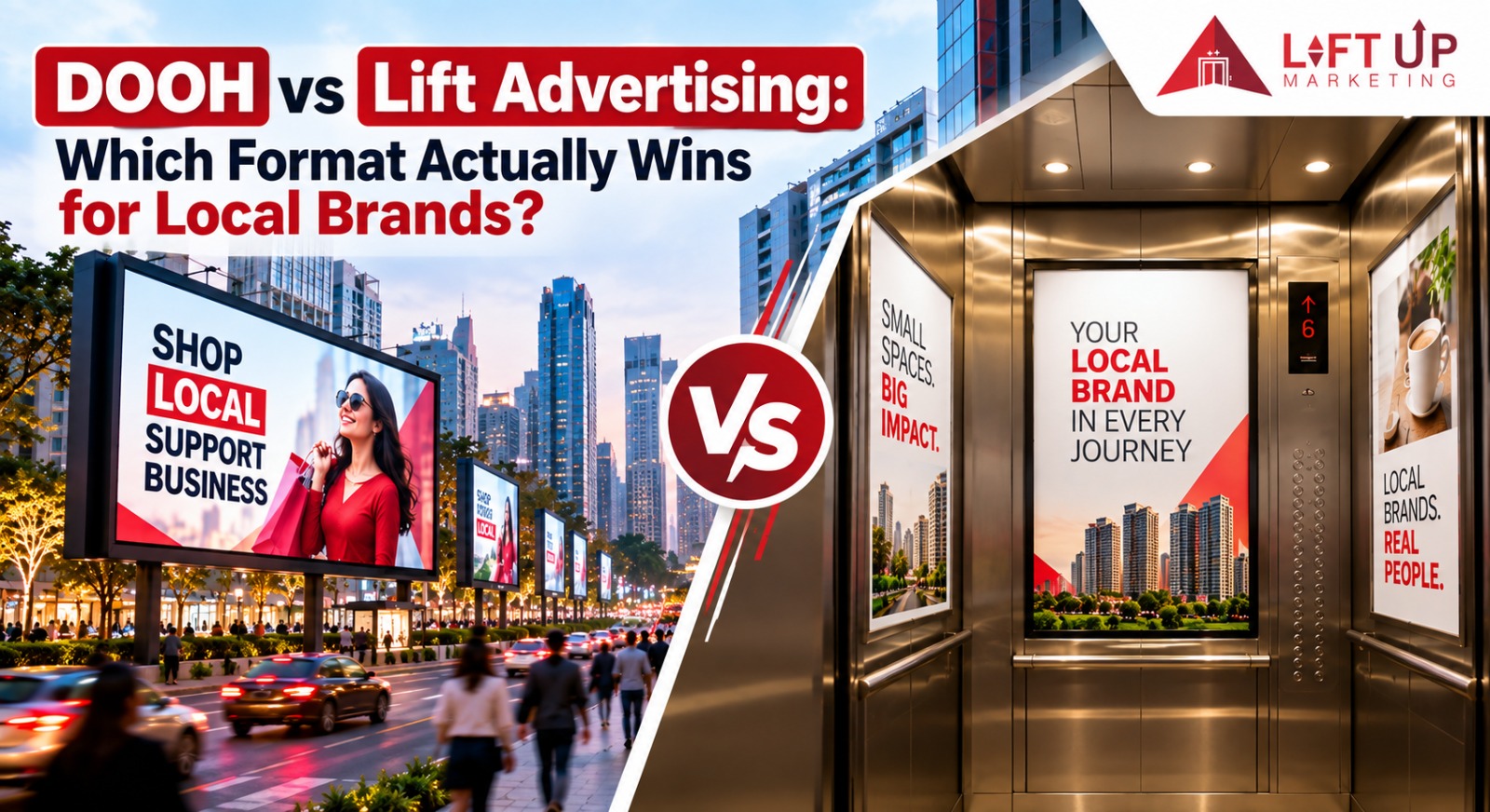
DOOH (Digital Out-of-Home) advertising uses digital screens — in malls, metro stations, and highways — to show rotating, data-driven ads to a broad public audience. Lift advertising uses physical posters inside residential and office elevators to reach a smaller, highly targeted, repeat audience. DOOH wins on scale, flexibility, and real-time content changes. Lift advertising wins on cost, hyperlocal precision, and daily repeated exposure to the exact households a brand wants to reach. For most local and small-budget brands, lift advertising delivers a stronger cost-per-relevant-impression, while DOOH suits brands chasing broad, city-wide visibility.
What Is DOOH Advertising?
DOOH stands for Digital Out-of-Home advertising — digital screens placed in public locations like malls, metro stations, airports, and highways, showing rotating video or image ads that can be changed in real time. Unlike traditional printed billboards, DOOH content can be updated instantly, targeted by time of day, and even adjusted based on live data like weather or traffic.
India’s DOOH sector is genuinely one of the fastest-growing parts of the advertising industry right now. While exact market-size estimates vary considerably between research firms — some value India’s total OOH market at roughly ₹6,500 crore, growing 10-15% year-on-year toward ₹7,900 crore by 2027 (Adonmo, October 2025), while other reports size the digital segment alone at USD 2.43 billion in 2025 (IMARC Group) — the one figure almost every source agrees on is the growth rate gap: DOOH is expanding roughly 4-8 times faster than traditional static OOH formats.
What Is a Lift (Elevator) Advertising?
Lift advertising, also called elevator advertising, places printed poster ads inside residential or commercial building elevators. Every time a resident or office worker uses the lift — often multiple times a day — they see the same ad for the duration of the ride, typically 20 to 60 seconds.
Unlike DOOH, lift advertising doesn’t rely on screens or connectivity. It’s a physical, static poster format, but its strength comes from something DOOH can’t easily replicate: a genuinely captive, repeat audience inside a specific building.
Key Differences: DOOH vs Lift Advertising
| Factor | DOOH | Lift Advertising |
|---|---|---|
| Format | Digital screens | Printed posters |
| Audience | Broad public — commuters, shoppers, travellers | Narrow, specific — residents/employees of chosen buildings |
| Targeting | By location, time of day, sometimes demographic data | By exact building/society — highly precise |
| Content changes | Instant, remote updates | Requires physical poster replacement |
| Typical cost | Higher (screen rental, content production, ad-tech) | Lower (print + placement fee) |
| Repeat exposure | Depends on commuter frequency at that location | Very high — daily use by the same people |
| Best for | Mass awareness, brand launches, broad reach | Hyperlocal targeting, community-specific recall |
| Setup speed | Slower (screen availability, tech integration) | Fast — can go live within days |
DOOH vs Lift Advertising Examples
DOOH in action: A food delivery app runs a digital screen campaign across metro stations in Mumbai, showing different offers during morning and evening commute hours — reaching thousands of commuters daily across the whole transit network.
Lift advertising in action: The same food delivery app could instead place posters inside 30 residential societies in a specific Gurgaon locality — reaching households who are actually likely to order from a nearby restaurant, with the same ad seen every single day by the same residents.
Notice the difference isn’t “better vs worse” — it’s broad reach vs precise, repeated local reach.
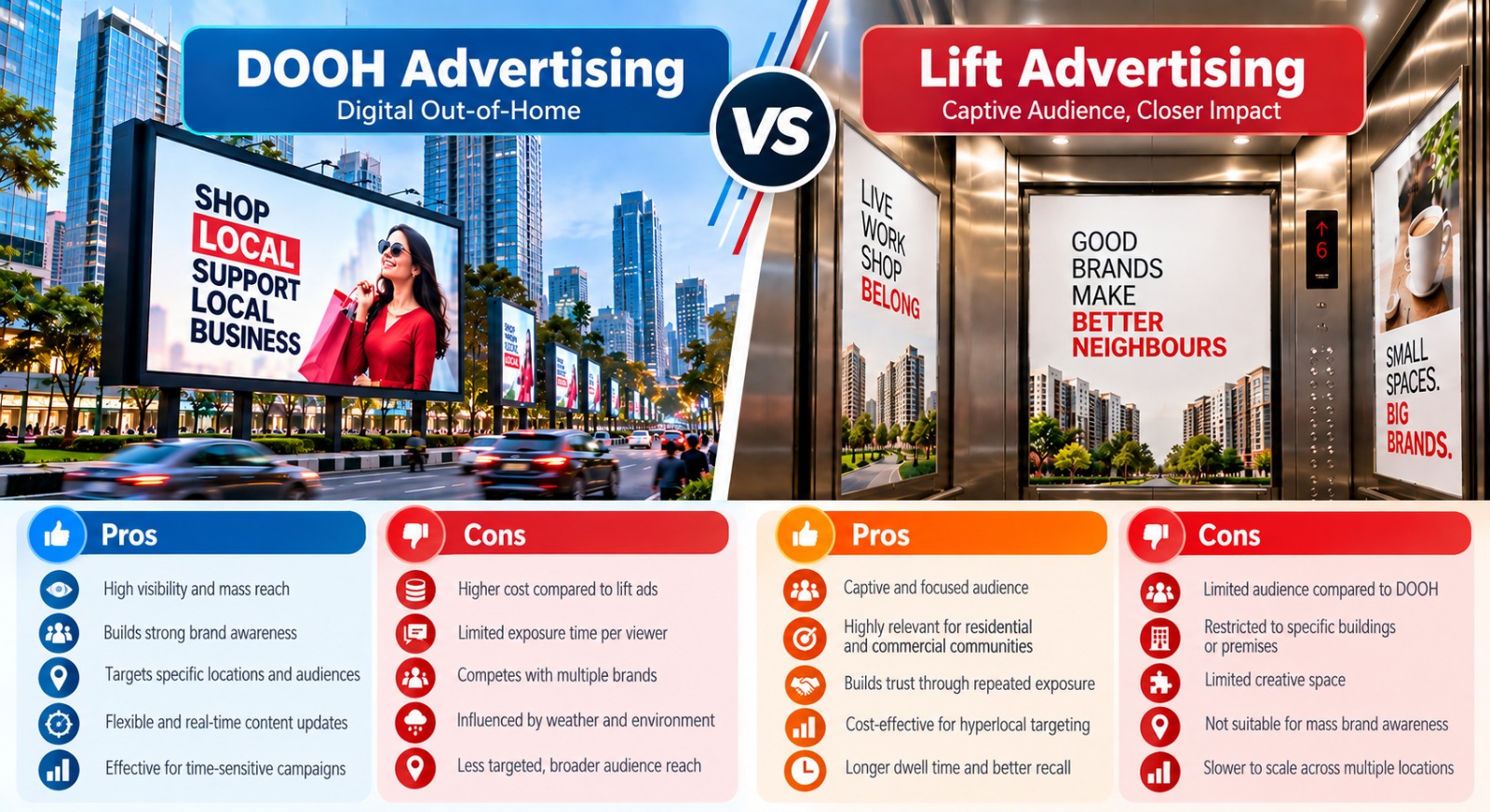
DOOH vs Lift Advertising: Pros and Cons
DOOH — Pros
- Real-time content updates and flexibility
- Can reach very large numbers of people across a city
- Rich media (video, animation) possible
- Data-driven targeting by time, location, sometimes audience segment
DOOH — Cons
- Higher cost, especially for premium locations
- Requires more lead time and technical setup
- Attention is often brief and competes with other visual noise
- Less precise for reaching a specific residential or professional community
Lift Advertising — Pros
- Lower cost, especially for hyperlocal campaigns
- Captive audience with minimal distraction during the ride
- Precise targeting down to specific buildings or societies
- Fast to set up and launch
- Strong repeat exposure builds recall over time
Lift Advertising — Cons
- Static content — can’t be changed instantly like a digital screen
- Smaller audience size per location compared to a busy DOOH site
- Less suited to broad, mass-market brand awareness goals
DOOH Advertising vs Lift Advertising in India: Which Should You Choose?
The honest answer: it depends on your goal, not which format is “better.”
Choose DOOH if:
- You want broad, city-wide brand awareness
- Your budget supports premium screen placements
- You want dynamic, changeable creative (time-of-day offers, live updates)
Choose lift advertising if:
- You want to reach specific residential communities or office buildings
- Your budget is limited but you still want strong recall
- You’re a local business — food delivery, coaching, healthcare, real estate — whose customers live in identifiable buildings
- You want a fast, simple campaign launch without technical setup
Many growing brands actually use both — DOOH for broad city-level awareness, and lift advertising to convert that awareness into local, repeated recall in the specific neighbourhoods that matter most.
Benefits of DOOH Advertising
- Real-time flexibility — change creative instantly based on time, weather, or events
- High visual impact — video and motion graphics grab attention more than static print
- Scalable reach — one campaign can span multiple high-traffic locations across a city
- Data-backed targeting — increasingly integrated with audience analytics and programmatic buying
Why Lift Advertising Still Holds Its Ground
Despite DOOH’s rapid growth, lift advertising remains genuinely effective for one simple reason: most digital and outdoor formats fight for a few seconds of divided attention, while a lift ride offers uninterrupted, repeated exposure to people who are already your exact target audience — the actual residents of the buildings you choose. For local and small-budget brands especially, this combination of precision and repetition is hard to match at a comparable cost.
FAQs
Q1. What is the difference between DOOH and OOH?
OOH (Out-of-Home) is the broader category covering all outdoor advertising, including static billboards, posters, and transit ads. DOOH (Digital Out-of-Home) is the digital subset — screens that display changeable, often data-driven content, as opposed to fixed printed media.
Q2. What are the three types of advertisements?
Advertising is broadly grouped into traditional (print, TV, radio), digital (social media, search, display ads), and out-of-home or place-based (billboards, transit ads, lift advertising, and DOOH screens) — each serving different reach and targeting goals.
Q3. What is a lift in advertising?
“Lift” in advertising refers to elevator advertising — placing poster ads inside residential or commercial building elevators, reaching a captive, repeat audience of residents or employees during their daily ride.
Q4. What are the benefits of DOOH advertising?
DOOH offers real-time content flexibility, high visual impact through video and motion, broad scalable reach across multiple locations, and increasingly data-driven targeting through programmatic ad buying.
Q5. Is lift advertising cheaper than DOOH?
Generally, yes. Lift advertising typically involves lower production and placement costs compared to DOOH’s screen rental, content production, and ad-tech integration, making it more accessible for smaller, hyperlocal campaigns.
Q6. Can small businesses use DOOH advertising?
Increasingly, yes — DOOH is becoming more accessible to smaller and regional advertisers due to flexible booking formats and shorter campaign periods, though lift advertising often remains the more budget-friendly option for genuinely local targeting.
Sources
- Adonmo / AdGully — India OOH Market Analysis, October 2025
- IMARC Group — India Digital OOH Advertising Market Report, 2025
- PwC — India OOH and DOOH Market Forecast
Note: Market size estimates for India’s OOH and DOOH sectors vary meaningfully across research firms due to differing methodologies and scope. Figures above are presented with their original source for transparency — always cross-check current figures before using them in a formal proposal.
Related Reading
Want to Reach the Exact Households That Matter to Your Brand?
While DOOH chases broad city-wide visibility, LiftUp Marketing helps brands reach specific residential communities directly — with fast setup, precise targeting, and a cost structure built for local businesses. Learn how it works or get in touch to plan your campaign.